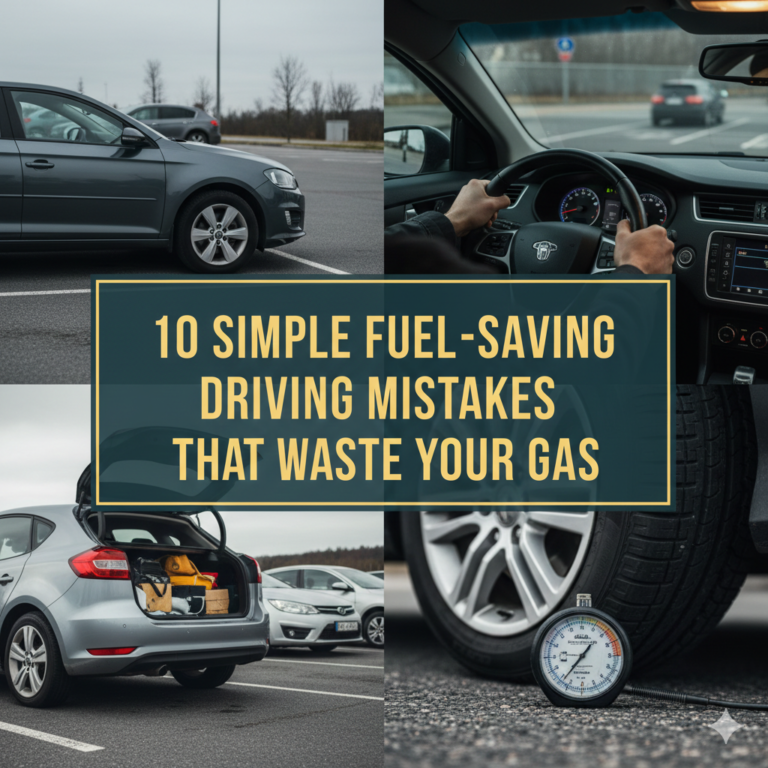
Quit Wasting Money Out Your Tailpipe
You fill up your tank once a week, sigh as the numbers mount on the gas pump display and lament how fast that tank of gas seems to vanish.
The issue isn’t always your car. It’s most likely how you drive it.
The vast majority of drivers waste fuel day in and day out without even knowing it! Little missteps can turn into hundreds of wasted dollars each year. The good news? Those mistakes are easily correctable once you identify them.
You don’t need a new car — or costly modifications. If nothing else, a few relatively small changes in the way you drive and manage your car can improve your fuel economy by 10% to 40%. That’s money you have back in your pocket.
Ready to stop wasting gas? Here are the ten biggest fuel-saving driving mistakes and how to avoid them.
Mistake #1: Driving Like You’re Racing
Not much you can do behind the wheel will burn fuel more quickly than driving aggressively.
The Problem with Heavy Acceleration
When you open up the throttle, your engine drinks fuel to produce that surge of power. Street racing off from a red light puts your engine to work at its least efficient.
A 15 to 30 percent reduction of fuel economy on the highway, research shows. In stop-and-go traffic, the waste spikes to 40 percent.
Hard Braking Wastes Your Work
Each time you brake to a stop, you waste all the fuel it just took to speed up. You are literally turning gas into brake dust and heat.
Most drivers do that all day long, this speeding up and slamming the brakes. And every cycle siphons a little more fuel away.
The Better Way
Accelerate smoothly and gradually. Act like there’s an egg beneath the gas pedal that you don’t want to break.
Anticipate traffic ahead. When you see brake lights up ahead, or a red light in the distance, take your foot off the gas and coast. Instead of accelerating just to brake, let your car’s momentum propel you forward.
And this type of easy driving can improve your city gas mileage by 3 to 5 miles per gallon.
Mistake #2: Leaving Your Engine Running For Eternity
In other words: Your car uses fuel while it sits in place, engine running.
How Much Fuel Idling Wastes
One-quarter to one-half gallon of fuel is the average rate of consumption an engine uses per hour at idle. It may not seem like a lot, but it all adds up.
If you idle for a mere 10 minutes a day, that’s over 60 hours per year. Half a gallon an hour, when you’re emitting 30 gallons of gas without moving once a year.
Common Idling Scenarios
When most people would be idling their cars:
- Waiting to pick someone up
- Sitting in drive-through lines
- Warming up the car in winter
- Sitting in traffic that’s not moving
- Waiting at railroad crossings
The Fix
Cold weather or not, new engines shouldn’t require more than 30 seconds of warm-up to get going. Start your car and drive gently for the first few minutes. You warm the engine up more quickly driving than when idling.
Stop your engine if you expect to be stuck for more than a minute. Re-starting consumes less fuel in terms of the time spent idling.
A lot of new cars have automatic start-stop systems that do this for you. If your vehicle has it, do not deactivate this feature.
Idling Cost Calculator:
| Daily Idle Time | Gallons Wasted Yearly | Annual Cost at $3.50/gallon |
|---|---|---|
| 5 minutes | 15 gallons | $52.50 |
| 10 minutes | 30 gallons | $105.00 |
| 15 minutes | 45 gallons | $157.50 |
| 30 minutes | 91 gallons | $318.50 |
Mistake #3: Racing on the Expressway
Many people assume that faster speeds yield better fuel economy. The opposite is true.
The Sweet Spot of Energy Efficiency
Your car is most efficient between 45 and 60 mph. On any speed above 60 mph, however, aerodynamic drag rises to the power of two.
At 65 mph, you’ll squeeze out maybe 30 miles per gallon. Bump that up to 75 mph and your mileage can fall to 24 mpg. At 80 mph, you may be down to only 20 mpg.
Why Speed Kills Your Mileage
The faster you drive, air resistance is your greatest enemy. Your engine has to fight a lot harder to cut through an ever thickening wall of air.
This resistance grows with the square of your speed. The effect isn’t linear; doubling your speed from 40 to 80 miles per hour doesn’t double the resistance — it quadruples it.
The Smart Approach
Drive the speed limit or just under it. For every 5 mph you drive over 50 mph, it’s like paying an additional $0.27 per gallon for gas.
Use highway cruise control. It does a better job holding a steady speed than your foot can. This most basic device can save you 7% to 14% on your highway fuel economy.
Forget about cruise control on hilly terrain, though. It can squander fuel by stomping on the gas up hills.
Mistake #4: Hauling Unnecessary Weight
Altogether it’s extra weight, which makes your engine work harder on every journey.
The Weight Penalty
Every extra 100 pounds reduces your fuel economy by approximately 1% to 2%. It may not seem like much, but it adds up.
If you have an extra 200 pounds of junk in your trunk, you could be wiping out 2 percent to 4 percent of your fuel economy. That can cost real money over a year.
What People Carry Around
Now go check your trunk, or back end. You’ll probably find:
- Old sports equipment you haven’t touched for months
- Tools you thought you would remove after a project
- Bags of shopping containing random goods
- Water or another beverage
- Emergency supplies you’ve been planning to sort through
Lighten Your Load
Take everything out of your car that isn’t an emergency necessity. Have a spare tire, jack, jumper cables and first aid kit. Everything else should come out.
You’re not driving around an overstuffed storage unit. Get it cleaned out in one trip; then put things back only if you find yourself using them.
This five-minute cleanup can save you up to $50 to $100 a year in fuel.
Mistake #5: Traveling with Roof Racks & Cargo Boxes on the Car
An empty roof rack or cargo box is a huge source of wind resistance.
The Aerodynamic Impact
Fuel economy is diminished 2% to 8% when a bulky rooftop cargo box is used in city driving. On the highway, that penalty rises to 6 percent to 17 percent.
At highway speeds, more than half of your engine’s effort goes into overcoming wind resistance. This is much worse when you put a big box on top.
Test Results
Consumer Reports tested three different kinds of roofs. One sedan saw its highway mileage drop from 46 miles per gallon to only 33 mpg when two bikes were carried on a roof rack. There’s a 13 mpg reduction just from two bikes.
Empty roof racks even suck fuel, slightly. They jut up into the wind and create turbulence that slows your car.
Better Solutions
Take off roof racks when you’re not using them. They are removed from most trucks in minutes, with readily available tools.
Opt for a hitch-mounted rack instead, if you can. These are situated behind the car in the slipstream and produce far less drag.
If you are transporting cargo, store it in the vehicle rather than up top when you can.
Mistake #6: Neglecting Your Tire Pressure
Underinflated tires are the simplest problems to remedy and one of the most prevalent.
How Tires Affect Fuel Economy
Tires naturally lose about 1 PSI of pressure every month. They lose an additional 1 PSI per each 10-degree decrease in temperature.
Your fuel efficiency can fall by as much as 10% if your tires are 20 percent underinflated. That’s a big penalty for such an easy problem.
Why Low Pressure Hurts
Underinflated tires cause greater rolling resistance. It is driving with the parking brake halfway on. Your engine is having to work harder to keep at speed.
Underinflated tires also wear unevenly, negatively impact handling and increase the chances of a blowout.
Check and Correct
Monitor your tire pressure every month at least one time. Do it when cold, before you’ve driven anywhere.
The proper pressure for your vehicle is indicated on a sticker inside of your driver-side door jamb. Do not use the number printed on tire sidewalls — that’s the maximum, not the recommended pressure.
Pump until the PSI reaches your desired level. This is five minutes of your time and free (at most gas stations).
Tire Pressure Impact Chart:
| Tire Pressure Status | Fuel Economy Effect | Annual Loss (15,000 miles) |
|---|---|---|
| Properly Inflated | 0% | $0 |
| 5 PSI Low | 1-2% increase in fuel economy | $18-36 |
| 10 PSI Low | 3-5% increase in gas consumption | $54-90 |
| 20 PSI Low | 8-10% increase in gas usage | $144-180 |
Mistake #7: Skipping Regular Maintenance
Your car burns more fuel when the engine is not properly tuned.
Dirty Air Filters
Your engine wants to breathe in order to burn fuel efficiently. A dirty air filter will restrict that air flow.
You can improve your gas mileage up to 10% on older vehicles simply by changing a dirty air filter. Today’s fuel-injected cars will do it for you, but a clean filter is still beneficial to performance.
Worn Spark Plugs
The spark plugs, however, fire millions of times as you ride. As they wear down through use, their effectiveness diminishes.
Misfires waste fuel, and they can be attributed to worn spark plugs. They also sap engine power and make your car run rough.
Old Engine Oil
The wrong grade of oil, or old, dirty oil causes more friction inside your engine. This friction is a power loss and fuel waste.
Follow your owner’s manual for oil changes. Follow the oil viscosity rules for your environment and driving style.
Faulty Oxygen Sensors
Your car’s oxygen sensor (also known as the O2 sensors) monitors and controls how much fuel your car needs to burn for optimal gas mileage. A bad sensor can reduce fuel economy by 3 mpg or more.
There are now check engine lights on modern cars that alert you when sensors go bad. Don’t ignore that light.
Stick to the Schedule
Follow your vehicle’s maintenance schedule. Scheduled tune-ups, oil changes, and filter replacements ensure your engine remains in good condition.
Well-kept cars get better gas mileage and they last longer. That money you spend on maintenance is paid back in fuel savings.
Mistake #8: Doing Too Many Short Trips
Cold engines waste fuel dramatically.
The Cold Engine Problem
At the time you start a cold engine, it runs rich (with excessive fuel), in order to create power and run well; a component of this gasoline is deposited onto the walls of the cylinders, and that makes completion more difficult. The engine has to warm up in order to work properly.
Short trips of 5 miles or less don’t allow your engine time to achieve its ideal operating temperature. You’re stuck in the least efficient part of your drive the whole way there.
Combining Errands Saves Money
Organize your outings so that you can complete multiple errands in one trip. Waste warm up just once for the engine and be warm for all those stops.
Rather than going 2 miles three times, go on one 6-mile trip that visits all three destinations. You’ll use less fuel overall.
Strategic Timing
If you’re out, run errands if possible. Get groceries on your way home from work instead of making a separate trip later.
Group your errands by location. Visit all the stores in one neighborhood and then move to another part of the town.
This takes a few extra minutes, but can save you 10% to 20% or more in fuel.
Mistake #9: Being Too Dependent on Your Air Conditioner
Air conditioning drains your engine.
The AC Fuel Penalty
Operating your air conditioner can cut fuel economy 15% to 25%. The impact is even worse in smaller vehicles and stop-and-go traffic.
When your A/C compressor is on, it is pulling power from the engine. This power is a consequence of burning surplus fuel.
When to Use AC
At highway speeds, run the air conditioner. Closing windows enhances your car’s aerodynamics, which reduces the amount of energy needed to drive it—so you’ll spend less money on gas.
Open the windows instead at lower speeds and when weather allows. Under 40 mph, the drag of an open window is less than the fuel cost of AC.
Smart Cooling Strategies
If you can, park in the shade. The cooler the car, the less AC is required to cool it off.
Open the windows wide and let the hot air out, then turn on the AC. That takes away the first need for cooling.
Once the car is cool, turn on recirculation. It’s less taxing to cool already-cool air than hot air from outside.
Use a moderate heat. Don’t set the AC to the coldest temperature. You will get comfortable sooner and burn less fuel.
Mistake #10: Poor Route Planning
To waste your time and fuel chances by inefficient routes.
Stop-and-Go Traffic Kills Mileage
Heavy stop-and-go driving can lower your gas mileage by 40% compared to steady highway cruising. All of that stopping and starting is just burning fuel without moving you forward very efficiently.
Construction zones, school zones and heavily congested areas all force you to drive in the worst possible pattern for fuel economy.
Navigation App Benefits
Today’s modern navigation apps, such as Google Maps and Waze, display current traffic conditions. They move you around the congestion (provided you opt in).
Those apps can save you a lot of fuel costs by preventing:
- Traffic jams
- Road construction
- Accidents blocking lanes
- Rush hour congestion
Trip Planning Strategies
Get traffic updates before you head out. If your route is gridlocked, wait half an hour, or use a different route.
Schedule your travels so that you are not traveling during rush hours, if possible. Time your morning commute, 15 minutes’ difference could mean cruise instead of crawl.
Choose routes with fewer stops. A slightly longer route on the highway can help save fuel if a short route has 20 traffic lights.
Combine errands to form efficient loops, rather than making separate back-and-forth trips.
How Much Money Can You Save?
Let’s look at real numbers. Suppose you typically drive 15,000 miles a year and gas is $3.50 per gallon.
If with your current habits your car gets 25 mpg, you consume 600 gallons per year at a cost of $2,100.
By correcting only half of these errors, you could raise your mileage to 28 mpg. At 536 gallons annually, it’ll cost $1,876.
And then you save $224 a year by adjusting a few habits.
You could save $400 to $600 a year if you corrected all 10 of these mistakes. That’s real money that stays in your pocket rather than going up in fumes from your tank.
Begin Small, Build Better Habits
Everything does not need to be fixed all at once. Begin with the one or two shifts that feel easiest.
Perhaps you start by testing your tire pressure this weekend. That will take, like, five minutes to do and cost nothing.
Forget about that roof rack you haven’t used in months, too. Another ten minutes.
The next week, concentrate on the ease of acceleration and coasting to a stop. After a few days, you will do this automatically.
Each incremental change is added to the existing precedent. At the end of a month, you’ll have changed your driving style and your fuel bills will decrease visibly.
For more fuel-saving driving tips and techniques, you can explore comprehensive resources that help you maximize your vehicle’s efficiency.
Beyond Fuel Savings
These driving improvements not only save gas. They also:
- Minimize wear on brakes, tires and engine
- Lower your stress while driving
- Strengthen your safety on the road
- Reduce emissions and environmental impact
- Make you a more courteous driver
There just isn’t any downside to smooth, efficient driving. Last longer car, calm arrival you — and let more money left in your wallet.
Your Action Plan
Here’s what to do this week:
Today: Take a tire gauge to your ride, nix any unnecessary weight and go for a rip.
This weekend: If you’re not using them, take off your roof racks or cargo boxes. Clean out your trunk completely.
Next week: Efficiently accelerate and brake softly. Coast to stops when possible.
Ongoing: The easiest way to avoid traffic is to plan your route. Combine errands into single trips. Shut off your motor instead of idling.
Keep track of your gas mileage for a couple of weeks. You will be able to watch the improvements in real time. That evidence will inspire you to continue doing the right thing.
Frequently Asked Questions
Is it more fuel-efficient to drive with the windows down than A.C. on?
It depends on your speed. At high speed (above 50 mph), open windows increase aerodynamic drag far more than running the AC. Windows for city speeds of less than 40 mph is more efficient. Hit the AC for highway driving; drop the windows in town.
How many minutes do I need to warm up my car in the winter?
Among modern engines, 30 seconds is the limit for warm-up time—whether in freezing weather or not. Start your car, wait 30 seconds and then drive in a calm manner for the first several minutes. You let the engine idle when it warms up slower that way than while you’re driving.
Would premium gas boost my fuel economy?
No, unless your car calls for premium gas. Putting premium in a car meant for regular does nothing but throw your money away. Refer to your owner’s manual and use the recommended grade. According to the U.S. Department of Energy, using premium gas in a car designed for regular fuel provides no benefit.
What’s one mile per gallon worth to me?
If you drive 15,000 miles a year and gas is going for $3.50 a gallon, an increase from 25 mpg to 26 mpg will save you about $84 in fuel costs every year. Increasing fuel economy to 30 mpg, from 25 mpg, will save $350 annually.
Will I hurt my car if I cut it off and on a lot?
No. Today’s starters are designed for many more starts than you will put them through in normal use. Killing your engine when you are stopped for more than a minute can save fuel and does not harm your starter.
Does driving with the cruise control on consume less fuel?
Yes, on flat highways. Cruise control helps keep the speed more constant than most people do when driving and can increase fuel economy by 7 percent to 14 percent. Turn it off on hilly roads, where it could downshift unnecessarily.
How reliable are fuel economy meters in new vehicles?
Most are accurate within 5%. Weak relative feedback, but can still at least know your inexact percentage even if the absolute values are not that accurate. Use them to experiment with different driving behaviors and how they impact your mileage.
What’s the biggest factor that I can control to save fuel?
Slow down and accelerate smoothly. More fuel is wasted by aggressive driving than any other factor. Just driving more gently can improve your fuel economy 20% to 30%.