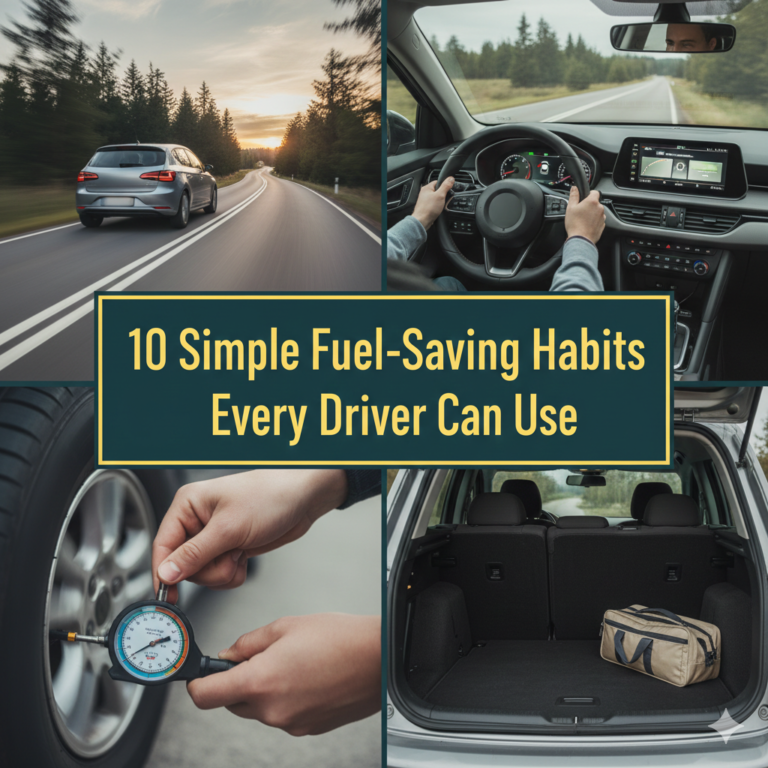
Introduction
Your car guzzles gas more than it ought to. Each mile comes with a tax higher than it should be. The issue isn’t your car — it’s how you drive it.
High gas prices and inefficient cars are most often blamed by drivers grappling with those bills. But the real culprit is behind the wheel. Your driving style dictates how much gasoline your motor gobbles up on each journey.
The good news? You can break these habits right now. No expensive modifications needed. No special equipment required. Ten simple techniques that work for sedans, trucks, SUVs and everything in between.
These aren’t theory or guesswork. And they’re effective strategies grounded in science and engineering, from automotive engineers and fuel efficiency experts. Average drivers who follow these steps have saved between 20% and 30% in fuel.
Consider what you spend in gas each month. And now try cutting it to a quarter or maybe a third. That’s actual money that stays in your wallet, rather than getting incinerated out of your exhaust pipe.
Here are ten fuel-saving driving tips that turn every car into a more economical green machine.
The Science Behind Fuel Consumption
Before we get into individual habits, let’s take a quick look at what consumes fuel in your car. Consumption is governed by three main conditions: Load of the engine, aerodynamic friction, and rolling resistance.
Engine load is how hard your engine is working. Heavy acceleration increases load dramatically. So does a bit of extra weight. And so do hills.
At higher speeds, aerodynamic drag battles your car. The faster you pedal, the more air pushes back. This resistance intensifies exponentially, not linearly.
Rolling resistance is what happens when your tires touch the road. Under-inflated tires create more resistance. So does carrying unnecessary cargo.
Once you grasp these principles, the rest of the habits are pretty self-explanatory. Every one is designed to address one or more of these fuel-wasting factors.
Habit #1: The Psychology of Creeping Momentum
Putting down the gas pedal is like tossing money out your window. Quick acceleration lands your engine in a very inefficient zone, where it’s drinking fuel to dish up immediate power.
Your accelerator pedal isn’t a switch — it’s a knob. Respect it and finesse it.
The Five-Second Rule
If you’re coming to a standstill, leave yourself at least five seconds until you’re in the flow of traffic. This allows your motor to make power the proper way. There’s no one you’re racing to the next red light.
Watch racing and the fuel economy contests of professional drivers. They pick up speed so gently that riders barely know they are moving. You don’t have to be that extreme, but the point is the same.
Reading Your RPM Gauge
Keep your tachometer under 2,500 RPM during normal acceleration if you have a tachometer in your car. The higher the revs, the more fuel your engine burns per second. Click into the next gear (in a manual transmission) or let off the gas (if you’re driving an automatic) before the engine hits high RPMs.
The newer cars with fuel efficiency gauges have real-time economy readouts. Watch that number during acceleration. Prep yourself to be horrified by the amount of fuel that’s wasted when you really stomp on it off the line.
Habit #2: Map Out Your Route to Dodge Stop-and-Go Traffic
Each stop/start cycle is a waste of fuel. Your engine uses energy to accelerate, then you toss that energy in the garbage by braking. Then you repeat the cycle.
Disrupting this cycle can save serious gas.
Using Traffic Apps Effectively
Applications like Google Maps and Waze provide live traffic updates. Before you leave, check if your usual path is congested. And a route that’s slightly longer but flows smoothly can actually require less gas than a shorter one with numerous stops.
Highway miles are better for mpg on most vehicles than city driving. Though if you have the option, highways are your best bets.
Timing Your Trips
Avoid rush hour when possible. Leaving work 30 minutes later typically would leave more time for a commute, but you also would be able to avoid stop-and-go traffic. The same is true of errands — midmorning or early afternoon usually mean less crowded roads than lunchtime.
Where possible, bundle errands together and avoid the frequent trips across town. A cold engine is an uphill battle against fuel efficiency—so one long trip trounces three short.
Habit #3: The Constant Speed on Highways
Speed fluctuations kill fuel economy. For each time you accelerate, your engine does a lot. When you brake, you’re just wasting the energy you’ve already made.
Consistency is your friend.
Cruise Control Mastery
It’s the kind of car you can put on cruise control for a section of highway without a lot of traffic. The computer in your car will maintain speed more accurately than your foot ever could. Those little speed differences accumulate over hundreds of miles.
Today’s adaptive cruise control systems are even smarter. While the pace remains unchanged, they follow at safe distances. Use it religiously on your highway trip if you have this feature in your car.
The Speed-Economy Relationship
Here’s the uncomfortable truth: it costs exponentially more fuel to drive that much faster. For most cars, they get best fuel economy at about 50-60 MPH. For every 5 MPH over that sweet spot, you pay about a 7% penalty in fuel economy.
Check out this comparison:
| Highway Speed | Impact of Fuel Economy | Annual Fuel Cost Increase* |
|---|---|---|
| 55 MPH | Baseline | $0 |
| 60 MPH | -5% | $84 |
| 65 MPH | -12% | $202 |
| 70 MPH | -20% | $336 |
| 75 MPH | -28% | $470 |
*Assuming 12,000 annual miles, 25 MPG baseline, $3.50/gallon
If you slow down from 75 to 65 miles per hour, then you can save close to $270 a year. When driving large distances, you’ll always save money by doing nothing more than leaving fifteen minutes early and driving slower.
Habit #4: Think Far Ahead and Forecast Change
The vast majority of drivers stare at the bumper in front of them. Smart drivers look 10-15 seconds ahead on the road. One single habit alters everything about your consumption of fuel.
If you catch problems early, you can make small adjustments rather than abrupt shifts.
Traffic Light Reading
See the red light in plenty of time. As soon as you see a light ahead turn red, start coasting rather than holding your speed until you need to brake sharply. The light turns green before you even get to it much of the time, so that you can keep sailing on.
Time your approach so you get to the light as it turns green. This requires finesse but saves a ton of fuel in the long run.
Following Distance Benefits
Keep a three second cushion between you and the car ahead. That wiggle room allows you to transition seamlessly when traffic ebbs and flows. You can coast, rather than braking to maintain momentum.
Tailgating induces dynamic braking and acceleration cycles. The vehicle in front of you taps the brakes—you hit the brakes. They speed up—you accelerate. This pattern destroys fuel economy.
Highway Exit Planning
Begin the process of moving into your exit lane at least a mile before your exit. Slowly making lane changes at a steady rate of speed will save far more fuel than last-minute darts that call for braking and then heavy acceleration.
Habit #5: Take the Extra Weight Off Your Vehicle
Your engine doesn’t give a damn whether it’s pushing something useful or garbage. For every pound you’re hauling, it takes some energy to accelerate and then maintain that speed.
Time to clean house.
Trunk Archaeology
Look in your trunk: There’s a good chance there are things in there that you haven’t touched for months. Golf clubs from last summer. That case of bottled water. Old textbooks. Forgotten gym equipment.
Fuel economy decreases 1-2% for every 100 lbs of weight depending on vehicle size. In smaller automobiles, the impact is more significant.
Do a monthly trunk purge. Keep only the necessities: spare tire, jack, jumper cables, a few basic tools, first aid kit and emergency supplies.
Seasonal Equipment Rotation
Winter gear in summer? Summer gear in winter? Stop schlepping stuff you won’t use for months. Keep in garage to store snow chains, beach chairs, seasonal sports equipment when not in use.
Roof Storage Reality Check
Roof racks seem swashbuckling, but they destroy fuel economy. Even naked roof rails add some drag and knock your fuel economy down by 1-2 percent. Put a cargo box or kayak on it and we’re talking 10-25% worse mileage at freeway speeds.
Remove roof racks between uses. If you need only occasional cargo space, rent a trailer or use a hitch-mounted carrier designed to ride in the wind shadow of your car.
Habit #6: Tire Pressure Should Be Treated as Diamonds
This habit of mind might sound like a bore, but it yields outsized results. Correct tire pressure minimizes rolling resistance, improves vehicle handling, helps maintain even treadwear, and reduces fuel consumption.
But most drivers ignore it until a tire appears visibly low.
Monthly Pressure Checks
Inspect all four tires once a month on the 1st day of each month. Analyze with a good digital tire pressure gauge ($10-20). Those gas station gauges can be way off.
Measure pressure when tires are cold — if the vehicle has been parked for three hours or more, before driving. Driving tires raises temperature and pressure for a short time.
Finding Your Target Pressure
You can find your car’s recommended pressure on a sticker inside that driver’s door jamb. It’s also in your owner’s manual. Do not rely on the maximum PSI printed on the tire sidewall — that figure is a safety cap, not a suggestion.
The majority of passenger cars require 30-35 PSI. Some of the newer vehicles with low profile tires require 40-45 PSI. Always follow manufacturer specifications.
The Cost of Under-Inflation
Tires could lose up to 1 PSI per month naturally, and an additional 1 PSI with every temperature loss of about 10 degrees. The colder months bring a double whammy for tire pressure.
Tires under-inflated by 8 PSI only can cut fuel efficiency by 3-4%. That’s $50-70 in gas per year. Oh, and your tires wear prematurely, necessitating hundreds spent on replacements.
Here’s a seasonal maintenance guide:
| Season | Frequency of Check | What to Look For |
|---|---|---|
| Winter | Check every 2 weeks | Cold significantly lowers pressure |
| Spring | Check every 3 weeks | Gradually rising temperatures lead to higher pressure |
| Summer | Check once a month | Heat can expand air in tires |
| Fall | Check every 2 weeks | The lowering temperature will quickly decrease tire pressure |
Habit #7: Be Mindful with Air Conditioning
Your car’s A.C. is powered by your engine, at the compressor. This robs power and can increase fuel usage by up to 25% during severe heat.
But it’s not like sweating your way through summer is the solution. Smart AC use, while preventing fuel waste, keeps you comfortable.
The Window-AC Speed Threshold
At speeds less than 40 MPH open windows add almost no drag. At speeds above 55 MPH, open windows generate so much resistance that AC becomes more efficient.
Follow this rule: City driving, windows down; highway driving, AC on and windows closed.
Pre-Cooling Strategies
Park in shade whenever available. A shaded car is 20-25 degrees cooler than a sun-baked one; and less cooling means lower fuel consumption.
On hot days, keep all your doors open 30 seconds before getting in the car. This blows out superheated air at a rate that’s quicker than AC by itself. Then shut doors, start the engine and drive with windows open. After a minute, shut windows and flip on the AC.
Efficient AC Settings
Switch your system from fresh air to recirculate. It takes less energy to continue cooling air already cooled rather than constantly cooling hot outside air.
Whenever you can, park with your car’s nose facing away from the sun. The steering wheel and dashboard will not get surface-of-the-sun hot, which should slash initial AC demand.
If your vehicle has remote start, turn it on to start cooling the car down before you get in. The extra fuel isn’t that much compared to full-blast AC on a heat-soaked vehicle.
Habit #8: Reduce Idling As Much As You Can
Idling eats up fuel while you move exactly zero miles. That’s an infinite cost per mile traveled. But drivers idle without thinking all the time.
Modern motors do not have to be warmed up for 20 minutes. Thirty seconds is sufficient, even on a winter day.
The Ten-Second Rule
If you anticipate being stopped for more than ten seconds, shut off your engine. This applies to:
- Waiting for passengers
- Drive-through lines
- Railroad crossings
- Long traffic lights (when safe)
- Curbside pickup zones
Many newer vehicles come with auto start-stop systems that do this for you automatically. Do not turn it off if yours has this feature. It saves fuel more than you might expect.
Winter Warm-Up Myths
Your grandfather’s old tale about warming up a car for 10 to 15 minutes is no longer relevant. Almost from the get-go, modern fuel injection systems maximize efficiency.
Start your vehicle, wait 30 seconds and drive gently until the engine warms up. You’ll heat up sooner and use less fuel than if you were hanging out in your driveway.
Remote Start Considerations
Remote start is nice, but expensive. For all vehicles, idling consumes roughly 0.02-0.03 gallons of fuel per minute. Five minutes of remote start burns about $0.50 worth of gas.
Use remote start sparingly — not regularly, every day.
Habit #9: Maintenance and Regular Tune Ups
A poorly tuned engine is one that works harder and consumes more fuel. Routine maintenance keeps everything humming along.
Air Filter Replacement
A dirty air filter decreases the amount of air entering the engine, making it less efficient by up to 10 percent. Most air filters need to be replaced between 12,000-15,000 miles or once a year.
This is a five-minute do-it-yourself job. New filters cost $15-30. The operation pays for itself with fuel savings in a few months.
Spark Plug Inspection
Worn spark plugs can cause incomplete combustion and an increased waste of fuel. Today most spark plugs last 60-100,000 miles but check your owner’s manual for individual intervals.
New spark plugs can increase fuel economy by 4-5% when compared to worn plugs.
Oxygen Sensor Function
Your oxygen sensor is what tells your engine computer how to adjust the fuel to air mixture. Fuel economy can decrease by 20-40% if a sensor malfunctions.
There are some exceptions, but most O2 sensors last you 60-90k miles. When your check engine light comes on, have it diagnosed right away. A lot of check engine light concerns are with regard to fuel mileage. For more detailed information on vehicle maintenance and fuel efficiency, visit the U.S. Department of Energy’s fuel economy guide.
Oil Change Impact
Newer synthetic oils are more effective at minimizing internal engine friction than conventional oils. This is not huge, but 1-2% more fuel economy always helps.
Just make sure you’re using the right oil weight at the right intervals. If you go heavier than recommended on the oil, you’re creating friction and actually making it work less efficiently.
Habit #10: Opt For Spots Where You Minimize the Need to Work Later
The manner and location in which you park will determine your next departure. Strategic parking saves on fuel needed to regain the road.
Shade Seeking Benefits
We alluded to this earlier, but it’s worth the emphasis. Shaded parking will lower your cabin temperature by 15-25 degrees! And the less cooling needed, the less air-conditioning and the less fuel burned.
Shade also prevents fuel evaporation. For example, in extreme heat fuel can evaporate out of your tank through the fuel system’s vapor recovery system. Shade minimizes this loss.
Downhill Parking Advantage
Park downhill whenever there is an inclination. It means that your car will not be having too much trouble starting and resistance to acceleration.
This is a small thing, but little advantages add up over hundreds of rides.
Minimizing Backup Time
Choose pull-through spots when available. When you pull straight through you don’t have to back up and go forward, which saves you a few seconds of idling time and movement.
In parking lots, choose areas that make it easy to leave, rather than forcing you to work your way through parked rows of cars. Straight shots to the exit use less gas than maze-like meanderings.
Combining Habits for Maximum Savings
These ten habits are synergistic, not isolating. Begin by choosing three habits that will be easy to incorporate in your schedule. Become a master of them for two weeks, then add three more.
The Beginner Bundle
If you are just now learning conscientious fuel behavior, let’s start with:
- Gradual acceleration
- Maintaining tire pressure
- Reducing vehicle weight
These are the things that, once habits, take no thought.
The Intermediate Package
Once you have a foundation, try adding these:
- Traffic anticipation
- Consistent highway speeds
- Strategic AC use
Awareness of these needs to increase, but they return plenty.
The Advanced Approach
When it’s time to save like you mean it:
- Minimize idling
- Regular maintenance schedule
- Route planning
- Strategic parking
If all ten habits are fully embraced, one can expect a real-world mpg gain of 25-35%. For those who were spending $200 a month on gas, they would save about $50 to $70 a month, or between $600 and $840 a year.
Tracking Your Progress and Results
You can’t manage what you don’t measure. Begin to monitor your gas mileage so that you can actually see it pay off when you adopt these habits.
The Simple Tracking Method
Reset your car’s trip odometer when you fill up. At your next pit stop, take miles driven and divide it by gallons purchased. This is your true MPG for that tank.
Write this number in a little notebook or save it to your smartphone. After 5-6 tanks, you find your baseline. Then build new habits and look at your MPG climb.
Using Technology
Newer cars come with fuel economy displays installed. They’re not perfect, but they’re great for comparing one drive to another.
Apps (for your smartphone) such as Fuelly, GasBuddy and Drivvo can help you log fuel purchases, compute miles per gallon and see trends over time.
Setting Realistic Goals
Don’t expect overnight transformation. 5-10% better fuel economy in your first month is not only achievable, it’s relevant. Slowly getting to 20%-30% improvement over the course of some months is the kind of firm foundation that leads to real life alterations!
Celebrate milestones. Be sure to acknowledge the accomplishment when you reach your best MPG tank ever. Positive reinforcement cements new habits.
A Few Common Hurdles and Potential Solutions
Drivers, in spite of good intentions, can be hard-pressed to keep such fuel-saving habits.
“I Don’t Have Time to Drive Slowly”
This is the most popular excuse. Reality check: Traveling 65 MPH rather than 75 MPH tacks on about an extra minute and a half per 10 miles. You get there 3 minutes later, and you’ve saved $3-4 in fuel.
However, most people squander more than three minutes a day on phone scrolling or coffee runs. Prioritization matters.
“My Car’s Just Inefficient”
Efficiency varies by vehicle, but how you drive matters more than you may realize. An excellent driver in a 20-MPG SUV can keep up with or even best a bad driver in a 30-MPG sedan.
You won’t change your car overnight, but you can change your habits today.
“These Habits Feel Unnatural”
Everything feels weird at first. Remember learning to drive? That felt unnatural too. It takes three weeks to establish a new pattern of behavior. They’ll become automatic.
Concentrate on a single habit, rather than trying to tackle everything at once.
“Other Drivers Get Annoyed”
Efficient driving does not involve holding up traffic. Accelerate reasonably—not glacially. Drive the posted speed limit — not below it. Signal early and maintain awareness.
Polite, efficient driving dovetails with the normal flow of traffic.
Real Drivers, Real Results
Sarah from Michigan saves $85 in gasoline per month with these habits. She has a 2015 Honda Accord and commutes 40 miles a day. Her MPG increased from 27 to 34 over three months.
In Texas, Marcus was able to slash 22% off his truck’s fuel usage. His 2018 Ford F-150 has moved up from 16 MPG to 19.5 MPG — not amazing in absolute terms, but enough of a difference that he is saving $70 per month.
Jennifer in California added good maintenance to these driving habits. Her 2012 Toyota Camry now gets 37 MPG, compared with 29 MPG. The upkeep cost her $200 but within ten weeks she had more than made that back in fuel savings.
And these aren’t superstars with some kind of magic. They’re ordinary drivers who decided to focus on fuel economy and made some basic changes.
FAQ Section
Q: Will these practices work on older vehicles?
A: Absolutely. In older vehicles, the benefits are often even greater, as their engines tend to be less advanced. The physics of motion, friction and aerodynamics do not vary with vehicle age. A 2000 sedan will respond to efficient driving as well as a 2024 model.
Q: How long before I see a return on my savings at the pump?
A: You should notice some changes in a tank or two of gas. That said, allow for 3-4 tanks to form a consistent pattern. Tank ranges vary depending on weather, traffic and type of trip. True improvement trends over many tanks.
Q: Can I apply these habits to a hybrid or electric vehicle?
A: Partially. Hybrids benefit from all of these behaviors. Electric vehicles don’t have conventional engines, but smooth acceleration, proper tire pressure, reduced weight and minimizing climate control use extend range considerably. In an EV, aggressive driving can shave as much as 30-40% off of range.
Q: Aren’t I damaging my engine by “babying” it?
A: No. Modern engines are designed by engineers to run well at a range of RPMs. Gradual acceleration and moderate speeds are well within normal parameters. You’re not doing any harm — you’re using your engine the way it was designed.
Q: What about hilly areas which require constant acceleration?
A: Physics still applies. You’ll use more fuel than a driver on a level road, but efficient habits can still cut fuel use versus aggressive driving in hills. Anticipate hills to maintain momentum and avoid excessive speed before climbing.
Q: When I coast downhill, should I put the car in neutral?
A: No. This is risky and usually illegal. Modern fuel-injected engines use zero fuel when coasting in gear with your foot off the gas. Putting the car in neutral actually burns a tiny bit of fuel to maintain the engine idling. Keep your car in gear for safety and efficiency reasons.
Q: Do fuel additives do any good?
A: The vast majority of fuel additives accomplish little, if anything for modern vehicles. Top tier gasolines already have enough additives. There’s no need to buy anything special; just focus on driving habits instead. If you have a specific engine problem, consult a mechanic, rather than relying on miracle additives.
Q: How does the weather influence the efficacy of these fuel-saving behaviors?
A: Cold weather reduces fuel economy by 10-20% due to denser air, cold engine operation, and increased accessory use (heaters, defrosters). Hot weather impacts economy through AC usage. These habits still pay off in all weather — they just yield less absolute benefit when it’s extremely hot or cold.
Conclusion
Ten practical fuel-saving driving habits for any car aren’t complicated or difficult. They don’t need mechanical know-how or expensive modifications. All the habits in this guide operate on rudimentary physics and common sense.
Your car is already capable of better fuel economy than you’re currently achieving. The divide between what you’re getting and what you could get comes down to habits — how hard you press the pedals, whether your car is properly maintained and how you organize your trips.
Start small. Pick 3 practices from this list that you resonate with. Work on them for a two-week period consistently until they become habit. Then add three more. In a matter of months, you’ll have completely changed your driving and fuel consumption.
And the money you save adds up month after month, year after year. Over the course of 10 years, efficient driving translates into thousands of dollars saved—more than enough money for an amazing vacation or a substantial down payment.
And that’s beyond the money: By driving efficiently, you cut emissions while extending the life of your vehicle and becoming a safer, more mindful driver. It’s these side benefits that make good fuel-saving practices worthwhile even if gas prices plummeted tomorrow.
The 10 practical fuel-saving driving habits for any car are now yours to implement. Your path to better gas mileage begins the very next time you leave your driveway. Make it count.