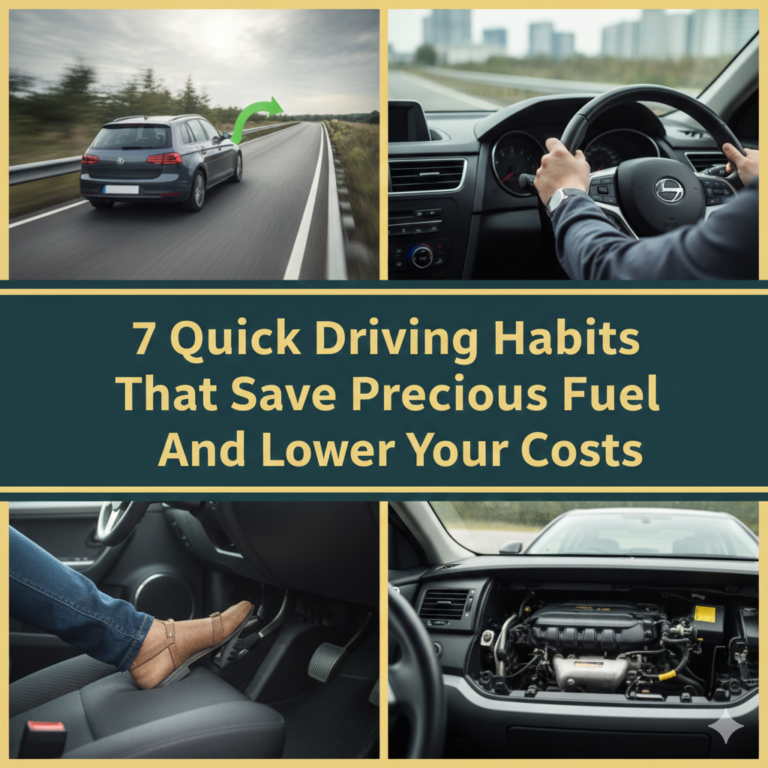
Quit Tossing Your Money Out the Window
Imagine this: every time you take a car to work, or the grocery store, or anywhere you drive, you are literally spending money—watching it evaporate. Not just because of high gas prices (although they do remain fairly high), but also because of how you’re driving.
Here’s a surprising statistic: the typical driver fritters away somewhere between $400 and $600 per year because of bad driving habits. That’s money that could go toward vacation, gifts or into saving. The crazy part? You can solve the problem today without spending a dime.
You don’t need a hybrid car. You don’t need expensive gadgets. You just need to use the right techniques.
This guide shows 7 quick fuel-saving driving habits that work NOW. These are not complex tactics that take months to master. They’re easy changes you can make on your next trip for instant benefits. Some drivers say they are saving 20-30 percent on their fuel bill within the first week.
Ready to keep more of your hard-earned money for yourself? Here are the seven habits that will change how much you spend filling up at the pump.
1. The Gentle Touch: Master Smooth Throttle Control
More than your speed is determined by your right foot. It dictates the amount of money you spend on gas. One of the quickest ways to empty your fuel tank—and your wallet—is hard acceleration.
Imagine the gas pedal as a volume knob, not an on-off switch. When you mash it, your engine drinks fuel like a person tasked with downing water after running a marathon. You sip fuel efficiently when you touch it gently.
Drive like there is a sleeping baby in the back: Accelerate smoothly. Try to accelerate gently enough that there’s a sleeping baby in your back seat. Or alternatively, keep imagining there’s a full cup of coffee on your dashboard.
City fuel economy will instantly improve by 15-20% due to this single habit. That one habit will save you one tank of gas every five tanks you buy.
How to Accelerate Smoothly
- Count to five once you go from 0 to 30 mph
- As you accelerate, check your RPM gauge and ensure it’s under 2,500 RPM
- If your engine is loud and sounding stressful, then it’s working too hard
- Use eco mode in your car if it has one—it will limit aggressive acceleration, helping you achieve even better results
The very next drive, you will test the effects of this driving technique. It’s common to see your fuel economy display and witness your numbers improve right before your eyes.
2. Coast Like a Pro: The Art of Early Deceleration
Professional race car drivers appreciate one incredible secret: you spend less time on the brakes; you achieve faster rates. The same philosophy applies to fuel economy. The less you brake, the less fuel you’re wasting.
Each time you hit the brakes hard, you are throwing the energy and fuel spent accelerating out the window. It’s like paying for your groceries, then throwing them out before leaving the store!
The solution is simple and solid: before you believe it’s required, you need to get off the gas. Way earlier than you think.
See a red light at the next intersection? Remove your foot from the gas immediately. Don’t wait until you’re 50 feet from the red light. Instead, coast while you’re 200-300 feet away. The car will naturally decelerate. You might not even need to hit the brakes if that light turns green.
This maneuver is known by a number of names: anticipatory driving, defensive driving, or simply “reading the road ahead.” Whatever you want to call it, it works.
How to Practice Coasting
Look 10 seconds up the road when you drive. That’s about:
- One city block in town
- A quarter mile on the highway
- The distance to the nearest set of traffic lights or stop sign
Once you spot a reason to slow down (red light, traffic backup, stop sign), ease off the gas. Let momentum take you forward while your engine consumes zero fuel.
Today’s fuel-injected engines shut off the supply of gasoline entirely when you coast in gear. That means you are basically traveling for free. No gas being burned at all.
Coasting Savings Breakdown
| Driving Scenario | Hard Braking Approach | Coasting Approach | Fuel Saved |
|---|---|---|---|
| Red light ahead (200 ft) | Maintain speed, brake hard | Coast 150 ft, brake gently | 15-25% |
| Traffic slowing ahead | Stay fast, brake repeatedly | Ease up early and roll slowly | 20-30% |
| Stop sign approach | Full speed until close | Coast from far away | 10-20% |
| Highway exit | Brake on exit ramp | Coast before exit | 5-15% |
Practice this for a week. You’ll be surprised how little you brake, and how much better your gas mileage becomes.
3. Speed Sweet Spot: Find Your Car’s Happy Place
Every vehicle has a “sweet spot” when it comes to getting the best fuel economy. For the majority of cars, that magic range is 45-60 mph. Drive faster, and your fuel usage takes off.
Here’s the reason: Air resistance increases with speed according to an exponential function. At 55 mph, your car slices through the air fairly well. At 75 mph the air resistance is nearly double. Your engine needs to push through twice as much friction and burn a lot more fuel.
The math is brutal. If you drive 70 mph instead of only 60 mph, you’ll have a loss in fuel economy from 15-20%. If you’re driving cross-country, that difference could mean $20-40 extra in your gas bill.
But here’s the key thing: you do not need to drive slowly. You just need to drive consistently at a reasonable speed.
The Consistency Factor
Speed changes waste fuel more than absolute speed. Each acceleration uses more fuel. Every time you decelerate, you are throwing away the energy that you recently used to get up to speed.
Religiously use cruise control while on the highway. It holds steadfast at the exact speed you request, free from the microscopic variations your foot would introduce. It turns out that we waste more fuel on these little micro-adjustments than you might imagine.
If you’re on a flat highway, use your cruise control at 60-65 mph. You save gas and you still get where you’re going at a reasonable time. Yes, there will be other cars on the road that pass you. Let them. They’re also hitting gas stations more frequently than you will.
Exception: On hilly terrain, you must turn off the cruise control. The cruise control either slams on the power as you climb hills (a waste of gas) or flies downhill at speed (missing free momentum). In the mountains, manual control beats cruise control.
4. Lighten Your Load: Remove Dead Weight Now
Your car uses fuel to move weight. Your weight, the weight of your passengers, the weight of your cargo—it all matters. The heavier your car, the more gas you have to burn for each trip.
Every 100 pounds of added weight can decrease fuel economy by 1-2%. That might not sound like much, but it can add up. Your gas mileage is reduced by 3-6 percent when you haul around an extra 300 pounds of stuff. Over a year, that may be wasting $75-150 in gas.
Do this right now: Walk outside to your car and open the trunk. What’s in there? Golf clubs that you have not touched in months? Tools you never need? Bags of sports equipment? A stack of books? Remove it all.
Clean out your back seat too. Old jackets, shoes, bags, cases of water—if you don’t need it today, take it out.
The Roof Rack Problem
The rack on your roof is a fuel hog. Even empty roof racks create lots of air resistance. A cargo box on your roof may reduce highway fuel economy by 15-25%. That’s massive.
If you need your roof rack once a month, then you’re wasting gas the other 29 days. Take it off when you’re not using it. Yes, reinstalling is a nuisance. But the fuel savings more than pay you back for your time.
If you do need to carry cargo, opt for a hitch-mounted carrier rather than one that goes on the roof. The aerodynamic penalty is dramatically less because it sits in your car’s “shadow” behind the vehicle.
Weight Removal Checklist
Empty your car and remove:
- Sports equipment (unless you have practice)
- Tools and repair kits (just keep emergency basics)
- Excess floor mats (heavy rubber ones particularly in summer)
- Cases of beverages (purchase as you need them)
- Old documents and papers
- Seasonal items (snow gear in summer, beach chairs in winter)
- Extra shoes and clothing
One driver took 200 pounds out of their SUV, and the vehicle’s fuel economy shot up from 18 MPG to 19.5 MPG. That’s 8 percent improvement after 30 minutes of work. Not too shabby for a half-hour’s labor.
5. Tire Pressure Magic: The Two-Minute Fuel Saver
Under-inflated tires are silent fuel thieves. They create rolling resistance, which causes your engine to work harder. The result? Every mile you burn more fuel.
Maintaining the right amount of pressure in your tires can increase your miles per gallon by 3-5%. Which may not sound like much, until you do the math: If you spend $2,000 a year on gasoline, correct tire pressure saves drivers $60 to $100. Every year. Forever.
Check your tire pressure monthly. Not when you remember. Not when they look low. Each and every month on the same day. According to the U.S. Department of Energy, proper tire maintenance is one of the easiest ways to improve fuel efficiency.
How to Check Tire Pressure Correctly
First, find the correct pressure. It’s on a sticker in your driver’s door or in your owner’s manual. Do not rely on the number that is posted on your tire sidewall—that’s the maximum pressure, not the recommended pressure.
Second, check tire pressure when tires are cold. “Cold” means you haven’t driven for more than a mile. Driving warms up tires and increases the pressure, giving you a false reading.
Third, use a quality tire pressure gauge. The ones at gas stations are frequently inaccurate. You can pick up a digital gauge for $10-15. It’s going to pay for itself in fuel savings within the first month.
Optimal Tire Pressure Strategy
| Tire Condition | Fuel Economy Impact | What To Do |
|---|---|---|
| 5 PSI under recommended | 1-2% loss | Add air immediately |
| 10 PSI under recommended | 2-4% loss | Add air and check for leaks |
| At recommended pressure | Baseline | Maintain monthly |
| 2-3 PSI over recommended | 0.5-1% gain | Optional for maximum economy |
Some drivers intentionally inflate tires 2-3 PSI above the recommended pressure to optimize fuel economy. This technique will work, but may slightly reduce tire life and ride comfort. It’s a trade-off to think about if you value fuel savings.
Free air pumps are available at most gas stations. Some even have digital displays that will automatically inflate your tires to a desired pressure. If free air is not available, spend $30 on a portable tire inflator. It’s worth it.
6. Smart Trip Planning: Combine and Conquer
Cold engines waste fuel. A lot of fuel. During the first 5-10 minutes after you turn on your car, fuel economy can be up to 40-50% lower than usual.
That means three short separate trips are wasting far more gas than one combined longer trip. The difference is significant.
For example, you may have to visit the bank, pharmacy and grocery store. Three individual trips may burn 3 gallons of gas. A single combined trip could require as few as 2 gallons. That’s 33% savings just from planning.
The Cold Engine Problem
When your engine is cold, several things happen:
- Fuel doesn’t vaporize efficiently
- Engine oil is thick and creates more friction
- Catalytic converter doesn’t work properly
- Engine computer runs in “warm-up mode” (uses extra fuel)
Everything needs 5-10 minutes of driving to warm up properly. All the while, you’re burning far more fuel than necessary.
Smart Planning Strategies
Combine errands into single trips. Make a list of everything you need to do. Plan a route that hits all stops in one journey.
Run errands on your way home from work. Your engine is already warm. Stop at stores on the way home from work, not by making separate trips from home.
Group appointments by location. Need to see the dentist and the eye doctor? If possible, schedule them both the same day in the same area.
Think about routing. GPS apps show the shortest distance, but not necessarily the most fuel-efficient route. A slightly longer route with better traffic flow often uses less gas than a shorter route with 20 traffic lights.
Consider walking or biking for very short trips. Trips under half a mile burn fuel at the worst possible rate because your engine never warms up. Walk or bike instead.
One study found that running errands during off-peak hours (mid-morning or mid-afternoon) can save 10-20% on fuel because you spend less time idling in traffic. If you can, don’t run errands during rush hour. For more fuel-saving driving strategies and tips, explore additional resources online.
7. Kill the Idle: Turn Off Your Engine
An engine that is idling burns fuel without getting you anywhere. It’s literally throwing money away.
How much fuel? About 0.25 to 0.5 gallons per hour depending on engine size. Doesn’t sound like much, does it? But 10 minutes of idling a day really starts to add up: $70-100 a year wasted.
The traditional wisdom that you needed to “warm up your car” is outdated. Modern engines don’t need it. They heat up quicker when you’re driving them gently than when they’re idling.
When to Turn Off Your Engine
Drive-through lines. If there are three or more cars ahead of you, turn off your engine. Even better: Park and go inside. It is frequently faster, and always more fuel-efficient.
Picking someone up. Don’t idle with the engine running in the parking lot. Turn it off and wait. Turn it back on when they are walking toward the car.
Railroad crossings. If you can see the train is still a mile away, turn off your engine.
Any stop over 10 seconds. That’s the break-even point. If you’ll be stopped for longer than 10 seconds (other than at a traffic light), shutting down saves fuel.
Automatic stop-start systems are fitted to many modern cars. The engine shuts down when you stop at red lights, then starts up again when your foot comes off the brake. Some drivers dislike this feature and turn it off. Don’t. It will save you 3-5% on fuel in city driving.
Idling Cost Calculator
| Daily Idling Time | Fuel Wasted Yearly | Annual Cost at $3.50/gal |
|---|---|---|
| 5 minutes | 7.5 gallons | $26 |
| 10 minutes | 15 gallons | $52 |
| 15 minutes | 22.5 gallons | $79 |
| 20 minutes | 30 gallons | $105 |
Think about your daily routine. How much time do you spend idling? In drive-throughs? Waiting to pick up kids? Warming up the car? Add it up and multiply by 365 days. The number might shock you.
What Your Fuel Savings Really Look Like
Let’s attach real numbers to these seven quick fuel-saving driving habits. Let’s say you drive 15,000 miles a year and currently average 23 MPG. At $3.50 per gallon, you spend about $2,283 on fuel each year.
Now apply these seven habits. Here’s what realistic improvements look like:
Habit 1 (Smooth acceleration): 10% improvement
Habit 2 (Coasting): 8% improvement
Habit 3 (Speed control): 5% improvement
Habit 4 (Weight reduction): 3% improvement
Habit 5 (Tire pressure): 3% improvement
Habit 6 (Trip planning): 5% improvement
Habit 7 (Reduced idling): 3% improvement
Combined, these habits could improve your fuel economy by 25-30%. Your MPG increases from 23 to about 29-30. Your annual fuel cost drops to $1,750-$1,825.
That’s $458-533 saved in the first year. Over five years, you’ll save $2,290-$2,665. Over ten years, you’ll save $4,580-5,330.
Remember, these habits cost nothing to implement. Zero upfront investment. You start saving money on your very next tank of gas.
Common Pitfalls That Block Your Savings
Even when people know these techniques, certain mistakes prevent them from seeing results:
Inconsistent application. Using these habits sometimes doesn’t work. You need to use them every time you drive. They must become automatic behaviors, not occasional tricks.
Impatience. Driving aggressively to save 2-3 minutes wastes more in fuel costs than those minutes are worth. Slow down and arrive relaxed and richer.
Forgetting to track progress. Calculate your MPG at every fill-up. Write it down. You need to see the improvement to stay motivated.
Ignoring maintenance. These driving habits work best when your car is well-maintained. A dirty air filter or bad spark plugs can cancel out your driving improvements.
Using premium gas unnecessarily. If your car doesn’t require premium, don’t use it. You’re wasting 50-75 cents per gallon for zero benefit.
Frequently Asked Questions
Q: Will these habits make me drive dangerously slow?
A: No. These techniques are about smoothness and consistency, not slowness. You can still drive at normal speeds and flow with traffic. You’ll just accelerate more gently and maintain steadier speeds.
Q: How quickly will I see fuel savings?
A: Immediately. You’ll notice better fuel economy on your very next tank of gas. Most drivers see a 15-25% improvement within the first week of consistent practice.
Q: Do these habits work for all types of vehicles?
A: Yes. These principles apply to sedans, SUVs, trucks, and even hybrids. Larger vehicles often see even bigger savings because they waste more fuel with bad habits.
Q: Will gentle acceleration make my car last longer?
A: Yes. Smooth driving reduces wear on your engine, transmission, and brakes. You’ll save money on both fuel and maintenance.
Q: Can I use these techniques in heavy traffic?
A: Absolutely. In fact, stop-and-go traffic is where these habits save the most fuel. Gentle acceleration and coasting are perfect for traffic situations.
Q: What if my car doesn’t have cruise control?
A: You can still practice steady speed manually. It takes more attention, but it works. Focus on maintaining consistent pressure on the gas pedal.
Q: Should I buy a fuel-saving device or additive?
A: No. Save your money. The Federal Trade Commission has tested hundreds of these products, and most don’t work as advertised. Your driving habits will save more money than any gadget.
Your Fast-Track to Fuel Savings Starts Now
You now have seven powerful, fast fuel-saving driving habits that cut fuel use immediately. These aren’t theoretical concepts or future possibilities. They’re practical techniques you can use on your next drive.
Start with three habits today. Pick the ones that seem easiest or most relevant to your driving. Master those first. Once they become natural, add the remaining four habits.
Track your results religiously. Calculate your MPG at every fill-up. Watch it improve week by week. Take photos of your odometer and receipts. Create a simple spreadsheet. The visual proof of your savings will keep you motivated.
Share these habits with everyone who drives your household vehicles. If your spouse, kids, or other family members drive, teach them these techniques. The savings multiply when everyone participates.
Remember that fuel-saving driving doesn’t mean driving like a timid driver. It means driving like a smart person who values their money. You’ll still get where you’re going on time. You’ll just keep more cash in your pocket when you arrive.
These seven fast fuel-saving driving habits work immediately. They cost nothing. They’re easy to learn. And they can save you hundreds or thousands of dollars over the next few years.