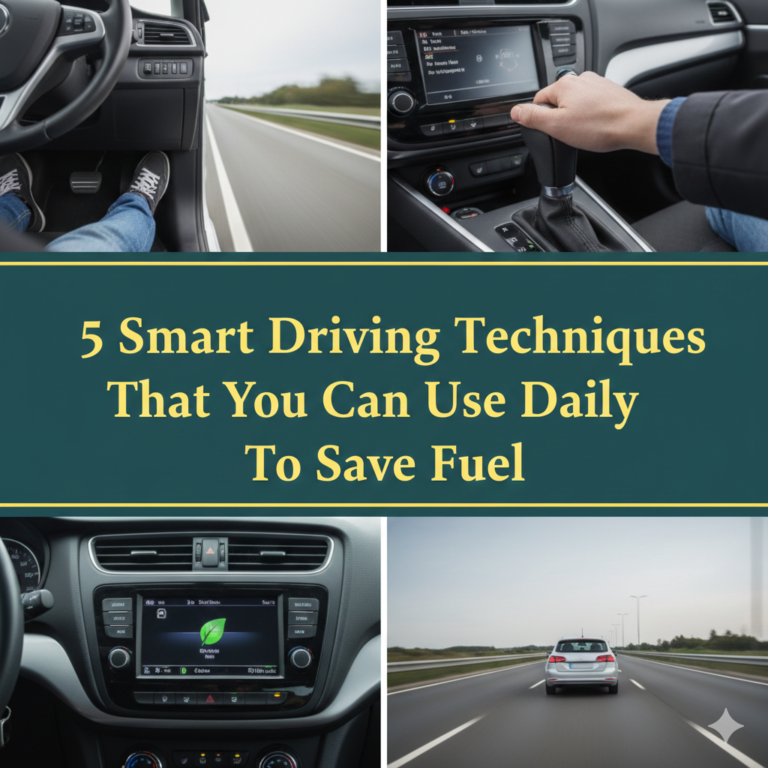
Little Tweaks Behind The Wheel That Add Up To Savings In The Bank
Gas prices are chewing through your weekly budget. You pull up to the pump, you see the numbers add up and you ask yourself if there’s even anything within your power to do about how much it costs.
The truth is, you have more power than you realize.
How you press the gas pedal, how you treat stop signs, and whether your foot rests in a particular position on the highway—these little things can make or break your chances of burning cash. These are techniques that virtually no drivers ever learn. They continue to act in ways that seem natural rather than those that actually do the trick.
In this piece, we highlight five intelligent fuel-saving driving habits that save gas daily. These aren’t theory. They’re techniques known and used by professional drivers, who are seeking maximum efficiency. The difference? You should begin to feel the results with your very first tank of gas.
Now let’s delve into the individual habits that will put money back in your pocket every time you drive.
Why Daily Habits Will Matter More Than One-Time Fixes
Many of us think of fuel economy in terms of big decisions. Should I buy a hybrid? Is premium gas worth it? Should I get a tune-up?
But this is what the numbers tell us: your daily driving behavior has a bigger impact on how much you spend filling up than any one of those decisions.
A driver with these five habits in a regular sedan will save more fuel than one driving a hybrid with bad driving habits. That may not sound like an exaggeration, but it is also basic physics—and driving skill.
Daily Fuel Waste vs. Smart Driving
| Driving Style | Fuel Used (per day) | Monthly Cost* | Yearly Cost* |
|---|---|---|---|
| Typical driving | 2.0 gallons | $210 | $2,520 |
| Smart habits applied | 1.5 gallons | $157.50 | $1,890 |
| Your Savings | 0.5 gallons | $52.50 | $630 |
*Based on 30 miles driven per day and $3.50 per gallon
That’s $630 a year in simple habit changes. No expensive modifications. No complicated technology. Just better technique.
Habit #1: Learn “Pulse and Glide” for City Streets
City driving kills fuel economy. All those stops and starts make your engine work harder. But there’s a trick that changes everything.
The technique is called “pulse and glide,” and professional hypermilers practice it on the open road to achieve phenomenal fuel economy numbers.
Here’s how it works:
The Pulse: Gradually and consistently increase your speed to that you wish to reach. Don’t floor it, but don’t crawl, either. Try to ease up to speed with moderate acceleration.
The Glide: When you have arrived at your desired speed, take your foot off the gas pedal completely. Let your car coast. You’ll be surprised to see how far your car goes before requiring more power.
When to pulse again: As you decelerate to around 5-10 mph less than your goal, apply another slight pulse of acceleration.
Why This Works
Powering up requires your engine to burn fuel in order to get going. You’re riding that momentum such that you’re using none of the fuel. Fuel-injected engines of the modern era, when coasting with your foot off the gas, use very little fuel.
Contrast that with steady-speed driving, when you apply a constant pressure on the gas. Your engine doesn’t get those free coasting periods.
Real-world example:
You’re cruising down a neighborhood street where the speed limit is 35 mph. Rather than keeping the pace at 35 mph all the time, you:
- Accelerate smoothly to 38 mph
- Lift off the gas and coast
- Let speed drop to 32 mph
- Accelerate again to 38 mph
This method can yield 10-15% gain in city miles per gallon versus steady state throttle.
Habit #2: Read the Colors of Traffic Lights Like a Professional Driver
One ability unites professional drivers—truckers, cabbies, and delivery folks. They read the traffic patterns ahead and slow down or speed up before most people even really realize what’s happening.
You can learn to do this in a week of practice.
The Traffic Light Strategy
Green lights on the horizon: Don’t expect them to remain green. If a light is green for a long time, it’s about to turn. Begin to come off the gas well before. If it goes yellow or red, you’re slowing down already. If it remains green, you sail through without wasting fuel.
Red lights at the next intersection: This is a no-brainer but you’d be surprised how many drivers don’t listen to this one. Back off the gas now. Coast toward the red light. The light turns green more often than you might think! And when it does, you are still moving rather than coming to a complete stop.
Yellow lights: Speed if you’re close enough to do so safely. If you are too far away, start coasting right away. Never zoom up to make the light—you’re wasting fuel by burning it to reach a red light.
The Distance Rule
Begin to slow down when you are at least 500 feet from a light. That leaves you lots of time to coast until you need to respond.
Watch drivers around you. Many don’t decelerate until they’re perhaps 50-100 feet away from the red light. Then they brake hard. They burned fuel until they are stopped. That’s literally throwing money away.
Habit #3: Discover the “Sweet Spot” Speed of Your Car
Every car has its sweet spot, a speed at which it gets the best mileage. For most vehicles, this range is between 45-55 mph.
But your particular car could be an exception. Knowing your vehicle’s sweet spot allows you to save fuel every day, generally on roads where you have the option of selecting your speed.
How to Find Your Sweet Spot
Step 1: Locate a flat, quiet stretch of road where you can hold a steady speed safely.
Step 2: Drive 5 miles at exactly 45 mph. If your car has that display, write down your instant fuel economy. If not, see how much the fuel gauge moves.
Step 3: Do the same at 50 mph, then at 55 mph, then at 60 mph.
Step 4: Your sweet spot is the speed which gives you the best fuel economy.
Using Your Sweet Spot Daily
| Road Type | How to Apply Sweet Spot |
|---|---|
| Highway (55-65 mph zones) | Stay at lower end of speed limit if traffic allows |
| Country roads (45-55 mph) | Perfect for sweet spot speed |
| City streets (25-35 mph) | Not applicable—focus on pulse and glide |
| Interstate (65-75 mph) | Accept lower economy, but avoid excessive speeds |
Once you know your sweet spot, you will begin to see opportunities where you can use it. That country road on the way to work? That is where you’re going to save the most fuel.
Habit #4: Practice “Defensive Fuel Economy”
Defensive driving prevents accidents. Defensive fuel economy prevents waste. The skills are more complementary than you might think.
That requires anticipating what the drivers around you are likely to do and altering your speed before needing to brake.
Key Defensive Fuel Economy Techniques
Following distance: Stay at least 3-4 seconds behind the car in front. This buffer allows you to coast when they slow down, rather than slam on the brakes. Closer following means more sudden braking, wasting all that fuel you poured into building speed.
Lane discipline: The right lane is usually the most even-paced. Sudden braking is reduced where there are fewer aggressive drivers. Unless you are passing, stick to the right and hold a constant speed.
Merge readiness: When a lane is closing ahead, slow down gradually to execute the zipper merge. Accelerating then stopping at merge points burns enormous amounts of fuel.
Parking lot entries: People tend to brake hard when pulling into parking lots. If you’re following someone going into a parking lot, coast early. They’ll slow down—be ready for them.
The Fuel Economy Savings
These maneuvers save fuel in two ways. First, you’re not throwing away the momentum you already had in motion. Second, you are taking the wear and tear off your brakes, meaning less maintenance.
Defensive driving for fuel economy often gets 8-12% better mixed-case fuel economy than aggressive drivers.
Habit #5: Use Engine Braking on Hills and Downslopes
Nearly every driver rides their brakes down hills. This wastes energy and shortens the life of brake pads. Smart drivers use engine braking.
Engine braking is using your transmission to slow down instead of your brake pads. It’s perfectly safe, and it saves fuel in a surprising way.
How Engine Braking Works
On the kind of modern cars that use fuel injection, when you lift your foot off the gas while in motion, the engine stops injecting fuel. While the engine assists in slowing you down, you’re basically using no fuel.
On automatic transmissions: Take your foot completely off the gas pedal when descending. For steeper hills, move into a lower gear (assuming your car has manual shift mode or L/2/1 positions). The engine will keep your speed without needing fuel or the brakes.
On manual transmissions: Downshift to a lower gear before descending. Let revs rise a little so there is some braking force. Don’t press the gas pedal.
When to Use Engine Braking
Long downhill grades: Perfect opportunity. Your engine is doing that holding of speed without wasting fuel and your brakes.
Approaching stop signs: Downshift early, and let engine braking bring you to a slow roll. Use your brakes only when making the final stop.
Mountain driving: Essential technique. You can overheat your brakes on long descents. Engine braking avoids it while saving gas.
Common Mistakes to Avoid
Don’t shift too aggressively. Smooth downshifts work best. Jerky shifts can upset the balance of a car and may even consume more fuel as its computer system compensates to smooth things out.
If you are driving an automatic transmission, don’t shift to low gear if the car is traveling at a high speed. First brake, then shift into a lower gear. Follow your owner’s manual guidelines.
Creating Your Personal Fuel-Saving Routine
These five habits are most effective when you mold them into your own daily ritual. Here’s how to do it.
Week 1: Focus on One Habit
Choose the habit that feels easiest to you. Perhaps it’s seeing traffic lights ahead. Only practice that habit all week. You should be used to it by day 4 or 5.
Week 2: Add a Second Habit
Continue to practice your first habit while adding a second. Smooth and consistent acceleration (pulse-and-glide) goes for most people hand-in-hand with reading the traffic lights.
Week 3-4: Construct a Full System
Continue adding one more habit each time. And around week four, naturally you’re doing all five techniques.
Tracking Your Progress
| Week | Habits Practiced | Average MPG | Fuel Cost Saved |
|---|---|---|---|
| Baseline | None (normal driving) | Your current MPG | $0 |
| Week 1 | Traffic light reading | +2-3 MPG improvement | $8-12 |
| Week 2 | Add pulse and glide | +4-6 MPG total | $16-24 |
| Week 3 | Add sweet spot speed | +6-8 MPG total | $24-32 |
| Week 4 | Complete system | +8-12 MPG total | $32-48 |
These numbers are based on 300 miles of weekly driving. Individual results will vary depending on your vehicle, driving conditions and consistency.
What About Highway Driving?
The highway is not the same as city driving. And some of those habits need to change.
Sweet spot speed: This will now be your go-to move. Once it’s safe, look for a speed in the 50-60 mph range at which your vehicle seems to run most efficiently and stick to that.
Pulse and glide: Not as effective on a highway. Use it if traffic gives you an opportunity. Heavy traffic makes this technique harder.
Traffic reading: Look for brake lights far ahead. Begin coasting well in advance when you notice vehicles slowing. This will help you avoid coming to a complete stop.
Engine braking: Works wonders on highway exit ramps and hills. Shift down before getting on your brakes.
Defensive spacing: Now more important than ever. Highway speeds mean following distance should increase to 4-5 seconds at a minimum.
Highway Fuel Economy Tips
Remain in the right lane except to pass. The right lane is usually slower moving. Left-lane drivers tend to accelerate and decelerate more often.
Leverage cruise control on the open road with moderate traffic. It remains steadier than your foot can maintain.
Do not pace with faster traffic. Just because the speed limit is 70 doesn’t mean that’s how fast you should travel. For every 5 mph over 60, you lose 7-10% in fuel economy.
The Tools That Help (And What Doesn’t)
Today’s cars have technology that can accommodate these habits. Some features help. Others actually hurt fuel economy.
Helpful Technology
Instant fuel economy displays: These depict instantaneous MPG. Use them to figure out what works best in your particular car. You’ll receive instant feedback when you coast versus accelerate.
Eco mode: This setting is available in most new cars. It adjusts throttle response for smooth acceleration. Turn it on and leave it on.
Auto start-stop: This turns your engine off when you’re at red lights. It works with these habits to maximize savings. Don’t disable it unless you have a specific reason.
Technology That Can Hurt
Sport mode: Makes acceleration more aggressive and keeps the transmission in lower gears. Complete opposite of fuel efficiency. Use only when you need performance.
Paddle shifters on automatics: Excellent for engine braking but some drivers use them to hang onto higher revs unnecessarily. Use them wisely.
Real-time AWD systems: If your vehicle has switchable AWD, drive in 2WD mode when the roads are dry. AWD adds weight and friction, which means worse fuel economy.
Common Questions About Saving Fuel on Your Daily Commute
How much time do these behaviors add to my commute?
Almost none. The next red light often turns green before you reach it when coasting to a stop. Steady highway speeds keep the stress level down without adding much time. Drivers mostly say they arrive at the same time, or even a bit faster, because they hit fewer red lights.
Will other drivers get upset if I drive like this?
Not if you drive for the conditions. Drive at safe speeds, do not block lanes and be considerate. These are habits that make you a smoother driver, not a slower one. Most other drivers won’t even notice.
Do these work in all weather conditions?
Yes, but adjust for safety. Safety is your number one concern, whether it’s raining, freezing or snowing. These techniques actually work well in bad weather because they focus on smooth inputs and avoiding sudden braking.
What if I own a truck or SUV?
For bigger vehicles, these habits are even more effective. Percentages translate to bigger dollar savings when you use more fuel (like in a truck or SUV). The principles remain the same no matter what size vehicle.
Can these be taught to my newly licensed teenager?
Absolutely. Teaching them these habits early on is the best way to shield young drivers from costly driving patterns. The majority of insurers provide discounts for drivers who exhibit smooth driving habits.
Measuring Your Success
You have to measure results to remain motivated. Here’s how to calculate your fuel savings accurately.
The Simple Method
Step 1: Fill your tank completely. Note the odometer reading.
Step 2: Drive for a week normally using these habits.
Step 3: Fill up again. Record gallons bought and your new odometer reading.
Step 4: Calculate Your MPG: (Miles driven) ÷ (Gallons used) = Your MPG
Step 5: Compare to your previous average.
The Detailed Method
Keep a fuel log. Record each fill-up with date, gallons, price per gallon, and odometer reading. In the long run, you will observe clear trends.
There are apps now that can keep track of this automatically. Many plug into your car’s diagnostic port and display real-time fuel economy.
Setting Realistic Goals
| Starting MPG | Realistic Improvement | Timeframe |
|---|---|---|
| Below 20 MPG | 3-5 MPG gain | 2-3 months |
| 20-25 MPG | 4-6 MPG gain | 2-3 months |
| 25-30 MPG | 4-8 MPG gain | 2-3 months |
| Above 30 MPG | 3-5 MPG gain | 2-3 months |
Bigger, less energy-efficient vehicles see larger absolute improvements. Smaller cars that are already efficient show smaller gains but still substantial percentage improvements.
Frequently Asked Questions
How soon can I expect to see results from these fuel-saving driving habits?
You will see increased fuel mileage within the first tank of gas. Most drivers report a 10-15% improvement during the first two weeks. You should start seeing full results in 4-6 weeks when the habits become automatic.
Are these habits helpful with electric vehicles as well?
Yes. Electric cars benefit from smooth acceleration, regenerative braking, and the ability to read traffic ahead. The principles are identical, except you’d be saving electricity rather than gasoline.
Will this damage my engine or transmission?
Not at all. These habits reduce stress on your car. Smooth acceleration and engine braking prolong the life of the engine, brakes and transmission. Your car will last longer, not shorter.
What if I occasionally forget and drive aggressively?
That’s normal. Nobody drives perfectly every trip. Focus on consistency over time. Even using these habits 70% of the time will save you significantly compared to never using them.
Can I use all five habits in one drive?
Yes, that’s the goal. Different situations call for different habits. City driving uses pulse and glide. Highways use sweet spot speed. Downhills use engine braking. With practice, you’ll start transitioning between them naturally.
Are there any situations where I shouldn’t use these habits?
Emergency situations always take priority. If you must speed up to be safe, do so. These routines are only for normal driving, not emergencies. And in extremely heavy traffic, focus on safety over fuel economy.
Start Your Daily Fuel Savings Today
Five habits. Five small adjustments to your driving. Cumulatively, daily fuel savings that may amount to hundreds of dollars a year.
The best part? You can begin employing these tactics on your next road trip. No special equipment needed. No expensive modifications. Just awareness and practice.
Think about your daily commute. How many stoplights are in your way? How many hills do you face? Each one is a chance to save fuel.
Begin with the habit that feels easiest. Perhaps you’ll start reading traffic lights farther ahead. Or maybe you’ll spend the weekend finding the sweet spot speed of your car.
Every little improvement adds up. You will build these habits in one month. You will forget how to drive any other way in three months. In 12 months, you can plan for a weekend getaway, build up your emergency savings fund or make some real progress toward paying off debt.
Fuel-saving driving habits that save you money every day don’t just trim fuel costs. They make you a better, safer driver. They relieve stress because you’re not constantly accelerating and braking. They help your car live longer since you’re treating it better.
Your car already has everything you need to save money today. The question is whether you are going to use it. For more advanced techniques and strategies, explore Fuel Saving Driving for additional resources. According to the U.S. Department of Energy, aggressive driving (speeding, rapid acceleration and braking) can lower your gas mileage by 15-30% at highway speeds and 10-40% in stop-and-go traffic.
Pick one habit. Practice it tomorrow. Watch your fuel gauge drop more slowly than usual. That’s money that stays in your account rather than going up in smoke on the road.