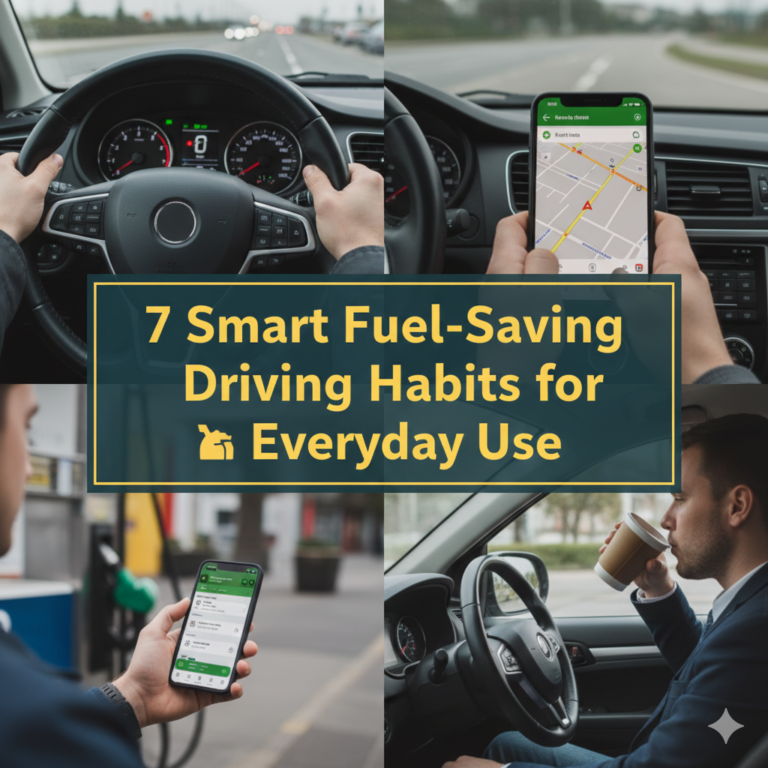
Your Driving Style Matters More Than You Think
Gas prices continue to rise, and every trip to the pump can feel like a blow to your wallet. Here’s something most drivers think about but probably don’t know: You have a bigger effect on your MPG than the vehicle you drive.
You may have the best fuel-economy car, but bad driving habits can still drain a tank faster than is needed. The flip side is that even an older car can defy expectations and be surprisingly economical if you know what you’re doing.
This post shares seven useful driving habits to help you save 20-30% on your fuel bill. These aren’t the complicated tricks that some people use, appealing to a gearhead’s mechanical knowledge. They’re easy changes that anyone can make and start today.
The best part? These habits not only save fuel. They also decrease wear and tear on your vehicle, reduce maintenance costs for you and make you a safer driver. Let’s take a look at each habit, and see how small adjustments behind the wheel can result in real savings.
Bad Driving Habits’ Financial Consequences
Before we can review the fixes, however, let’s take a moment to define the problem. Aggressive driving can lower gas mileage by 33% on the highway, and 5% on city streets, according to the U.S. Department of Energy.
Translating that into what it would mean if you usually get 25 miles per gallon, aggressive driving would bring that down to just 17 mpg on highways. For a driver traveling 15,000 miles per year, that distinction can lead to hundreds of additional dollars in expenses each year.
Here’s a simple breakdown:
| Driving Style | Highway MPG | Annual Fuel Cost* |
|---|---|---|
| Aggressive | 17 | $2,647 |
| Normal | 25 | $1,800 |
| Efficient | 30 | $1,500 |
*Assumes 15,000 miles driven annually, and regular gas is $4.50 per gallon
The table above demonstrates that you can save more than $1,000 a year just by altering the way you drive. Now let us figure out exactly how to do that.
Habit 1: Gentle Acceleration Is Your Greatest Ally
One of the greatest fuel wasters is a jackrabbit start. When you mash the gas pedal from zero mph, your engine burns much more fuel to deliver that spurt of power.
Visualize the egg under your foot like it’s an oversized high-powered gas pedal. You want to press in gently without going far enough that you would crack the shell. This visualization trains you to use a lighter touch.
How to practice smooth acceleration:
- Count to 5 when speeding up from 0-30 mph
- Try to keep your RPM gauge below 3,000 if you can
- Act as if you were holding a coffee cup with no lid
- Listen to your engine — if it’s loud, you’re pushing forward with too much power
Gradual acceleration means better fuel economy from your engine. You’re asking it to do less work in a longer period of time, and that means that you will consume less fuel per mile.
This tendency becomes even more crucial when we are entering the highway. Yes, you do need to hit highway speeds, but you can get there in a manner that is smoother as opposed to aggressive. Inching up to 65 mph over a long stretch takes far less fuel than stomping the pedal.
Habit 2: Learn the Art of Anticipation
Peering out and down the road isn’t just about staying safe — it’s also a potent fuel-saving maneuver. You see the future 10, 15 seconds up the road and you know to slow down because there’s a red light. But if you’d known that was happening, you could have coasted and saved gas.
Do you see that red light three blocks up there? Now take your foot off the gas and coast toward it. You’ll come up to the light just as it turns green, so you won’t waste fuel idling there.
Anticipation techniques that work:
- Observe the brake lights of cars three to four vehicles in front of you
- Observe traffic light sequences on your typical journeys
- Slow down early when approaching stop signs
- Give extra distance between you and the vehicle in front
This is a behavior that cuts down on the acceleration/brake constant back and forth cycle that kills your fuel economy. Every time you brake, you’re discarding the energy (not to mention fuel) with which you increased your speed.
That’s something professional truck drivers are forced to excel at, because they get paid to save fuel. They can go several minutes without even tapping the brake pedal, allowing momentum to carry them through a series of traffic maneuvers.
Habit 3: Drive at an Even Speed on Highways
Changes in speed are silent fuel assassins. Each time you floor it on the highway or jam on the brakes, you are making your engine run harder.
That’s where cruise control comes in as your secret weapon. It maintains a consistent speed exponentially better than your foot does. Even minor variations — speeding up by 5 miles an hour, then slowing back down again — result in a lot of wasted fuel during long trips.
The speed-fuel economy relationship:
| Highway Speed | Fuel Economy Impact |
|---|---|
| 55 mph | Baseline (best economy) |
| 65 mph | 10-15% worse |
| 75 mph | 20-25% worse |
| 85 mph | 30-35% worse |
Every 5 mph you drive over 50 mph costs you roughly 20 cents more per gallon. This happens because air resistance increases exponentially as you go faster. Your engine must work much harder to push through that resistance at 75 mph compared to 65 mph.
On longer highway trips, driving at 65 mph instead of 75 mph might add 15-20 minutes to a 5-hour journey. But you’ll save 2-3 gallons of gas, which translates to $10-15 in your pocket.
Set your cruise control and settle into the right lane. Let the speeders zoom past. You’re playing a smarter game.
Habit 4: Reduce Unnecessary Idling Time
Here’s a surprising fact: idling for more than 10 seconds uses more fuel than turning off your engine and restarting it. Yet many drivers let their cars idle for minutes at a time.
Modern engines don’t need extended warm-up periods. Thirty seconds is enough even in cold weather. After that, you’re just burning gas while going nowhere.
Common idling situations to avoid:
- Waiting in parking lots for someone
- Sitting in drive-through lines (consider parking and going inside)
- Warming up your car for more than 30 seconds
- Idling while talking on the phone
A typical car burns about a quarter gallon of fuel per hour while idling. If you idle for 10 minutes daily, that’s over 15 gallons wasted annually—roughly $60-70 thrown away for zero miles traveled.
Some newer vehicles have auto-stop technology that shuts off the engine at red lights. While some drivers find this annoying, it saves a measurable amount of fuel in city driving.
If you’re waiting somewhere for more than a minute, turn off the engine. Your starter can handle the restarts, and you’ll save fuel immediately.
Habit 5: Keep Your Vehicle Light and Aerodynamic
Every 100 pounds of extra weight reduces your fuel economy by about 1%. That might not sound like much, but it adds up when you’re carrying unnecessary items.
Clean out your trunk and back seat. Remove that old sports equipment, the extra set of golf clubs, or those bags of stuff you’ve been meaning to drop off for months.
Weight and aerodynamics checklist:
- Remove roof racks when not in use (they create significant drag)
- Clean out trunk storage
- Take off bike racks between trips
- Avoid filling your tank completely if you have short trips planned
Roof cargo boxes are terrible for fuel economy. They can reduce your gas mileage by 10-25% at highway speeds due to increased air resistance. If you use one for a trip, remove it immediately afterward.
Even an empty roof rack can cost you 1-5% in fuel economy. Those crossbars catching the wind might seem innocent, but they force your engine to work harder at every speed.
Think of your car as a package you’re shipping. The heavier and less aerodynamic it is, the more energy (and money) it takes to move it around.
Habit 6: Choose Your Routes Wisely
Not all routes are created equal for fuel economy. The shortest distance isn’t always the most fuel-efficient path.
Highway driving at steady speeds typically delivers better fuel economy than stop-and-go city driving, even if the highway route adds a few miles.
Route selection factors:
- Highways with consistent speed limits beat roads with frequent stops
- Avoid routes with steep hills when possible
- Skip shortcuts through neighborhoods with lots of stop signs
- Check traffic conditions before leaving
Modern GPS apps show traffic in real time. Sitting in gridlock absolutely destroys your fuel economy. You’re burning gas while barely moving. Sometimes taking a slightly longer route with flowing traffic saves both time and fuel.
Planning errands in a logical sequence also matters. Group your stops geographically so you’re not zigzagging across town. Make a loop that minimizes backtracking.
Consider traffic patterns too. Leaving 30 minutes earlier or later might mean the difference between smooth sailing and constant stopping, which directly impacts your fuel consumption. For more comprehensive strategies on fuel-saving driving techniques, explore additional resources that can help maximize your savings.
Habit 7: Proper Tire Pressure and Vehicle Maintenance
This final habit bridges driving technique with vehicle condition. You can’t achieve maximum fuel efficiency without proper maintenance.
Under-inflated tires are one of the most common fuel wasters. They increase rolling resistance, forcing your engine to work harder to maintain speed.
Essential maintenance for fuel economy:
- Check tire pressure monthly (do this when tires are cold)
- Follow manufacturer’s recommended pressure (found on driver’s door jamb)
- Change air filters as recommended
- Use the correct motor oil grade
- Keep up with tune-ups and spark plug replacements
Under-inflated tires can reduce fuel economy by 0.2% for every 1 PSI drop in all four tires. If your tires are 10 PSI low, you could be wasting 2% of your fuel—that’s $40-50 per year for most drivers.
Dirty air filters restrict airflow to the engine, making it less efficient. A clogged filter can reduce fuel economy by up to 10% in older vehicles.
Using the wrong motor oil grade increases internal friction in your engine. This might only affect fuel economy by 1-2%, but combined with other maintenance issues, the impact grows.
Regular maintenance isn’t just about reliability—it’s about efficiency too. A well-maintained engine burns fuel more completely and operates at peak efficiency.
Creating Your Personal Fuel-Saving Action Plan
Now that you know all seven habits, the question becomes: how do you actually implement them?
Don’t try to master everything at once. That’s overwhelming and usually leads to giving up. Instead, focus on one habit per week.
Week-by-week implementation schedule:
| Week | Focus Habit | Goal |
|---|---|---|
| 1 | Smooth acceleration | Practice gentle starts at every light |
| 2 | Anticipation | Coast to red lights, look ahead |
| 3 | Steady speeds | Use cruise control on highways |
| 4 | Reduce idling | Turn off engine for waits over 1 minute |
| 5 | Lighten vehicle | Clean trunk and eliminate roof racks |
| 6 | Choose routes | Select logical fuel-saving paths |
| 7 | Maintain regularly | Check tire pressure and schedule service |
Do this with every fill-up and keep track of your fuel economy. Divide miles traveled by gallons consumed. Check this number out as it gets better when you develop improved habits.
Just about every car nowadays has running fuel economy on the instrument panel. That’s something you can check out with this feedback tool that shows how driving translates into consumption on the fly. It’s like playing a video game where you’re trying to get the highest score.
Use your smartphone to take pictures of your odometer and fuel receipts. Seeing actual proof of your savings motivates you to stay at it for the long haul.
The Bigger Picture Beyond Your Wallet
Good fuel-saving habits give back more than just money in your pocket. Every gallon of gas you don’t burn is one less emission into the atmosphere.
Transportation is responsible for approximately 29% of U.S. greenhouse gas emissions. When considered together among a million drivers, more efficient habits add up.
You’re also reducing wear on important parts of your vehicle:
- Less aggressive braking means brake pads last longer
- Smoother acceleration reduces transmission stress
- Consistent speeds decrease engine wear
- Proper maintenance prevents expensive repairs
You’re also a safer driver because of these habits. The same habits that save fuel—looking ahead, holding a steady speed and keeping your space from other vehicles—are also what prevents crashes. You’re more aware of your surroundings and less prone to unexpected dangerous moves.
Your passengers will feel it. Smooth, predictable driving results in a more comfortable ride. There is no one who enjoys getting tossed around thanks to aggressive takeoffs and hard braking.
Real-World Success Stories
Many drivers have achieved dramatic results with these habits. Online fuel economy forums are filled with success stories.
One driver said they improved the fuel economy in their Toyota Camry from 28 mpg to 37 mpg—making it nearly a third more efficient—by simply adjusting driving habits. No tweaks, no modifications, just better technique.
A delivery driver saved their company over $3,000 per year by teaching all the drivers efficient techniques. The vehicles had not changed, but fuel consumption had fallen by 18 percent throughout the fleet.
These results aren’t unique. Studies repeatedly demonstrate that the manner in which a driver drives has more impact on fuel economy than any single parameter other than the vehicle.
Your results will depend on your current habits. If you’re already a fairly calm driver, you may see 10-15% improvement. If you have a heavy foot and aggressive style, 25-30% improvement would be easily attainable.
The only way to know is to give it a try and check the results.
Common Mistakes to Avoid
These are the things to watch for as you’re trying to form these habits—pitfalls that can derail your progress.
Mistakes that hurt fuel economy:
- Riding the brake while driving (keep your foot completely off when not braking)
- Accelerating up hills, then coasting down (maintain consistent pressure instead)
- Waiting to fill up the gas tank when almost empty (increases strain on fuel pump)
- Using premium gas when regular is recommended (provides no economy benefit)
- Believing fuel additives work miracles (most provide minimal benefit)
Some drivers get so focused on fuel economy that they become dangerous—coasting in neutral, driving far below speed limits, or blocking traffic. Don’t let efficiency compromise safety.
Other drivers abandon the effort after one week because they don’t notice a dramatic change instantly. Fuel savings accumulate over time. Keep it up for at least a month before drawing any conclusions.
Keep in mind that weather impacts fuel economy as well. Cold weather, headwinds and hilly terrain all sap efficiency no matter how careful a driver you are. Don’t be discouraged by short-term dips.
Technology That Can Help
Several tools can help you maximize your fuel-savings and give you useful feedback.
Useful fuel-saving technology:
- OBD-II scanners that display real-time fuel economy data
- Smartphone apps that track fuel consumption and suggest improvements
- Tire pressure monitoring systems (TPMS) for maintaining proper inflation
- GPS apps with traffic avoidance and route optimization
Many modern vehicles come with eco-driving modes that adjust throttle response and transmission shifting for better efficiency. These can help you develop better habits by making the vehicle naturally respond more smoothly.
Some apps gamify fuel economy, giving you scores and challenges. This makes the process more engaging and helps maintain motivation.
However, don’t rely solely on technology. The habits themselves matter most. Technology should enhance your skills, not replace your awareness and discipline.
Frequently Asked Questions
How much money can I realistically save with these habits?
Most drivers save 15-25% on fuel costs by consistently applying these seven habits. For someone spending $200 monthly on gas, that’s $30-50 saved each month, or $360-600 annually. Drivers with particularly aggressive habits can save even more.
Will driving slower make me late to everything?
Not significantly. The difference between driving 70 mph and 65 mph on a 30-mile highway commute is only about 3 minutes. That tiny time cost saves you considerable fuel. Plan to leave a few minutes earlier, and you’ll still arrive on time while spending less.
Does air conditioning really hurt fuel economy that much?
Yes, running AC can reduce fuel economy by 5-25% depending on conditions. However, at highway speeds, open windows create aerodynamic drag that can cost more fuel than AC. The best approach: use AC sparingly, park in shade when possible, and ventilate your car before turning on AC.
Are these habits harder on my engine or transmission?
Actually, the opposite is true. These habits reduce stress on your vehicle’s components. Smooth acceleration and braking are exactly what engineers design transmissions and engines to handle efficiently. Aggressive driving causes excessive wear.
Do older cars benefit from these habits as much as newer ones?
Yes, sometimes even more. Older vehicles often lack the efficiency features of modern cars, making driving technique even more important. The principles apply universally—physics doesn’t change based on your car’s age.
Can I use neutral or turn off my engine while coasting downhill?
Never coast in neutral in a modern car with fuel injection. When you’re in gear with your foot off the gas going downhill, fuel flow can completely stop. In neutral, the engine needs fuel to idle. Turning off the engine while moving disables power steering and brakes, creating serious safety risks.
Your Journey Starts Today
Fuel-saving driving habits aren’t complicated, but they do require awareness and practice. Like any skill, they become natural over time.
Start with one habit this week. Focus on smooth acceleration for seven days. Once that feels natural, add anticipation. Build gradually until all seven habits become automatic.
Track your progress. Calculate your miles per gallon at every fill-up. Watch the number climb as your skills improve. Share your success with family and friends—everyone can benefit from these techniques.
Remember that every dollar you save on fuel is a dollar you can spend on things you actually enjoy. These habits aren’t about deprivation—they’re about efficiency and making smarter choices.
The money you save over a year could fund a weekend vacation, pay for a nice dinner out once a month, or build your emergency fund. Small changes lead to meaningful results.
Your car’s fuel tank isn’t bottomless, but your potential savings are significant. Seven simple habits stand between you and hundreds of dollars in annual savings. The choice is yours, and the first step happens the next time you turn your key.
Drive smarter, spend less, and enjoy the satisfaction of mastering a skill that pays dividends every single day.