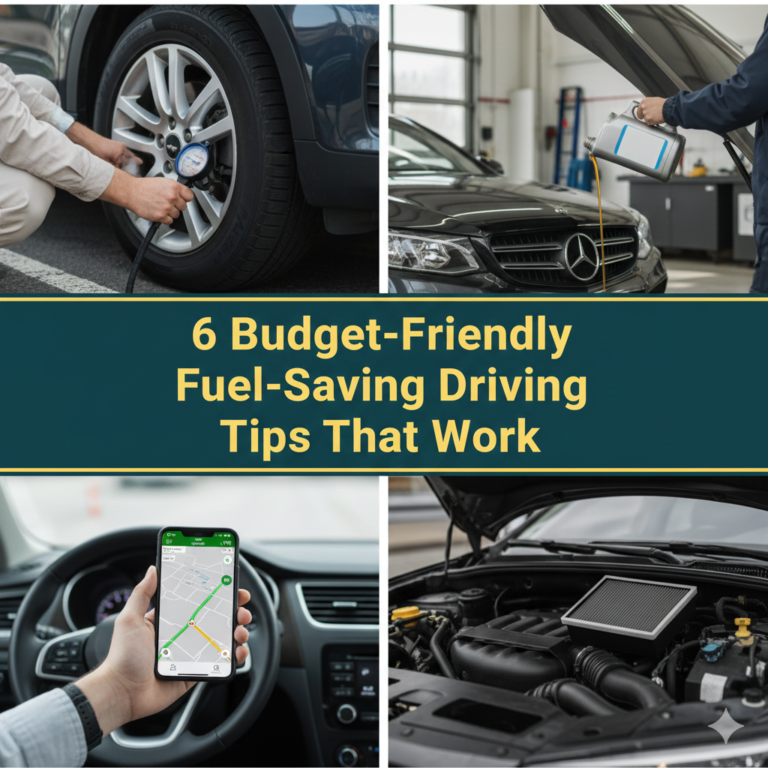
Introduction: Gas Is Hurting Your Wallet
Year by year, gas prices keep climbing. Every morning or evening, every school run or grocery trip—fuel expenses haunt you. On average, an American family spends more than two thousand dollars a year on gasoline. And believe it or not, you can spend little to no money and save up to 30% of fuel immediately.
The good news is you do not need to buy a new hybrid or install expensive fuel-saving technology to do that. Simple, generally unknown, but incredibly effective driving tricks can optimize your consumption and cut costs right away.
In this article, you will find six easily applicable budget tricks that will start working immediately. No complicated arrangements, no expensive installments—just regular habits that will end up saving you some extra money every month. Ready? Start reading.
Why The Way You Drive Means More Than The Price of Fuel
Most people believe fuel consumption is only about the price of gas per gallon. However, this sinfully simple vision is misled. Your driving habits have a significant impact on the amount of gas you spend. It may end up dramatically different for two drivers working, e.g., in identical cars.
The gas mileage may be 5-20% lower on highways and 10-40% drop in a stop-and-go mode while driving aggressively. Let’s help you stop throwing your money right out the window.
The U.S. Environmental Protection Agency says easy driver changes can increase your miles per gallon (MPG) 10-15%! And better MPG equals visiting the gas station less often.
The best part? All of these things cost nothing to do.
Tip #1: Slow and Steady Wins the Race — Focus on Smoothing Out Your Acceleration
Jackrabbit starts are fuel killers.
When you slam down the gas pedal at a green light, your engine is burning a whole lot more fuel than it needs to. It’s as if you were trying to run instead of walk to the same place.
How to Accelerate Efficiently
- Accelerate gently and gradually. Think of a raw egg beneath the gas pedal that you don’t want to break.
- Take 5 to 7 seconds to reach your desired speed not just 2 to 3. This allows your engine to run efficiently.
- Gently does it. Of course, if you drive an automatic transmission vehicle, taking the gentle approach can help to encourage your transmission to shift at lower RPMs. Low RPMs equal low fuel consumption.
The Numbers Don’t Lie
| Type of Acceleration | Direct Impact on MPG |
|---|---|
| Aggressive (hard) | Decrease in MPG by 15-30% |
| Moderate | No change to the baseline |
| Gentle (soft) | Increase in MPG by 10-15% |
That 10-15% efficiency bump can save you $200-300 a year if you drive a lot.
Real-World Application
When moving away from a traffic light, count to five as you gently press down on the accelerator pedal. You’ll feel your car ease up to the speed limit without a roar of the engine.
Sure, other drivers may zip ahead of you at first… but chances are good you’ll pass them again at the next red light. And you’ll consume orders of magnitude less fuel to get there.
Tip #2: Get in the Zone on Highways — Use Cruise Control
One of those is varying speed, a quietly inefficient source of fuel waste.
Each time you accelerate and slow down, your engine grows more burdened and wastes fuel. It’s like constantly applying and releasing the throttle on a lawnmower instead of just keeping it going.
The Cruise Control Advantage
Highways and long open roads are your friend when it comes to cruise control. It’s programmed to keep a steady speed, not the little speed variations your foot naturally creates.
Research indicates that by using a car’s cruise control fuel economy can be boosted by 7-14% on the open road. That’s significant savings over time.
When to Use Cruise Control
Best situations:
- Flat highways with minimal traffic
- Long-distance highway driving
- Rural journey with the same limit throughout
Avoid cruise control when:
- Driving hilly terrain (it makes the engine work harder going uphill)
- In stop-and-go and heavy traffic
- In the rain or on ice (safety first!)
The Sweet Spot Speed
There is a sweet spot for your car’s energy efficiency, typically between 45 and 65 mph.
Over 65 mph, fuel economy falls off a proverbial cliff. For every 5 miles per hour you drive above 65 miles per hour, it’s like paying an extra $0.20 for a gallon of gas.
You use 10-15% more fuel when you drive 75 mph as compared with if you go at 65 mph. On a long road trip, that is a lot of wasted money.
Tip #3: Time Lights/Intersections & Coast to Stops — Anticipate Traffic Up Ahead
This one is quite simple, and probably it happens all around.
And anticipation is a superpower when it comes to gas savings.
Good drivers look ahead and try to anticipate what they will face. Great fuel-savers perform a similar trick, only they factor in efficiency.
The Coasting Technique
Get off the gas early when you see a red light or stop sign up ahead. Instead, let your car glide to a gentle stop rather than accelerating toward it and then braking fiercely.
The method is two-fold in terms of fuel saving:
- Coasting is pretty fuel efficient (Don’t forget; your engine uses very little gas while coasting — some new cars use NO GAS on deceleration)
- You don’t have to deal with that gas-sucking full-throttle blast off from a standstill
Just How Far In Advance Should You Coast?
When driving, look at least 10 to 15 seconds ahead. That’s a few blocks when driving at city speeds.
If you spot brake lights ahead or a traffic light turning yellow, begin coasting at once.
Real Traffic Scenario
When you are driving in town, picture yourself seeing a red light 500 feet in the future.
Fuel-wasting approach: Barrel in at 50 and brake hard to a standstill. Punch it when the light turns green to regain speed.
Fuel-saving tip: Let off the gas at 500 feet, coast ever so gently to light. It may turn green before you’ve fully come to a complete stop, enabling you to preserve your momentum. And, even if you stop, you have saved fuel on the deceleration and so don’t require as much fuel during acceleration to get back up to speed.
The Momentum Advantage
Momentum is free energy. Every time you hit the brakes hard and come to a standstill, all that momentum is lost. Then you have to burn fuel to get it back up.
Smart drivers carry speed where they safely can.
Tip #4: Less is More — Reduce Weight and Drag
Your car is likely loaded with extra weight at the moment. And all that weight is costing you money.
The Weight-Fuel Connection
For an average vehicle, every 100 pounds of added weight costs you about 1-2% in fuel economy. For small cars, the impact is larger still (up to 3%).
Consider what’s in your trunk:
- Golf clubs you wore one time last month
- Boxes from your last move
- Tools you might need someday
- Winter emergency supplies in summer
All of that adds up. A new study discovered an average of 50-100 pounds of extra “stuff” is living in the average car trunk.
Clean Out Your Car Today
Take 15 minutes to remove things that you don’t use for daily driving. Keep only essentials:
- Spare tire and jack
- Emergency kit
- Documents required by law
All else can sit in your garage until such time.
The Aerodynamic Drag Factor
Wind resistance (drag) is created by roof racks and cargo carriers. That makes your engine struggle harder to do the same speed.
| Roof Load | Fuel Economy Penalty |
|---|---|
| Bare roof rack | 1-2% at highway speeds |
| Rooftop box | 10-25% depending on speed |
| Bike rack with bikes | 5-15% depending on configuration |
A roof cargo box can lower gas mileage by up to 25% at highway speeds. That’s massive.
Smart Solutions
- When not in use, remove roof racks. Most detach easily.
- If you need to haul anything, regardless of size, just attach a rear hitch cargo carrier. It generates less drag than top-mounted alternatives.
- Plan larger item transportation carefully. One trip using the trailer could save more fuel than months of reduced MPGs due to a permanent roof rack.
Tip #5: Check Your Tire Pressure Regularly
Super easy, super free, and often overlooked. But it is also one of the most effective gasoline-savers available.
Why Tire Pressure Matters
Under-inflated tires cause additional rolling resistance. You use more engine power to get the car moving.
According to the U.S. Department of Energy, correctly inflated tires can result in a 3% higher gas mileage. That may sound small, but it adds up.
Just one PSI (pound per square inch) drop in pressure on all tires reduces fuel economy by 0.2%.
Most vehicles have at least one tire that is significantly under-inflated. Which means most drivers are currently burning fuel needlessly.
Checking and Maintaining Tire Pressure
Step 1: Determine your car’s recommended tire pressure. It appears on a sticker inside the driver’s door jamb or in your owner’s manual.
Step 2: Check when the tires are cold (not used for driving for at least 3 hours).
Step 3: Use a tire pressure gauge (available at all auto parts stores, about $5-10).
Step 4: Inflate with air at the gas station as necessary. Most offer free air.
Step 5: Check monthly. Tires will typically lose 1-2 PSI per month.
Common Tire Pressure Mistakes
Mistake #1: Reading pressure after the tires have heated up. This gives falsely high readings.
Mistake #2: Relying on what “looks right.” You can’t feel a 5-10 PSI difference.
Mistake #3: Over-inflating tires to help with fuel economy beyond what is actually helpful. This is a traction reducing condition which will cause abnormal tire wear.
The Safety Bonus
Correct tire inflation has more to do than simply with fuel savings. It also:
- Extends tire life by 25-50%
- Improves vehicle handling
- Reduces the risk of blowouts
- Shortens braking distance
You stretch your fuel budget AND don’t have to replace tires before their time.
Tip #6: Combine and Route Plan Your Trips
The trip planning part may sound dull, but it’s also a potent fuel-saver.
The Cold Engine Problem
Your engine runs poorly when it’s cold. Trips of short duration, during which the engine never has a chance to fully warm up, can use twice the amount of fuel required for longer trips.
Those little trips to the store, post office and pharmacy one at a time? They’re fuel killers.
The Smart Approach
Multi-task and do errands in one trip whenever possible.
Instead of:
- Monday: Groceries (3 miles round trip)
- Tuesday: Pick up from pharmacy (2 miles round trip)
- Wednesday: Drive to dry cleaner (4 miles round-trip)
- Total: 9 miles, 3 cold starts
Do this:
- Monday: Grocery store → pharmacy → dry cleaner (6 miles round trip)
- Total: 6 miles, 1 cold start
You’ve just avoided 3 miles and 2 cold starts. That’s on the order of 20-30% less fuel for the same errands.
Route Planning Strategies
Plan stops geographically. Plan your stops to avoid going back and forth.
Avoid left turns. Seriously. UPS saves millions of gallons in fuel each year by using a routing system that requires mostly right turns. The less time people sit at intersections, the less fuel gets wasted.
Use traffic apps. Apps such as Google Maps or Waze display traffic information up to the minute. Sitting in traffic jams is no way to destroy fuel economy. A slightly longer way that places less demand on you, your vehicle and the environment is often a more efficient use of fuel.
Know the best times. Running errands at 10 a.m. on a Tuesday takes less out of the gas tank than 5 p.m. on a Friday. Less traffic makes for more efficient driving.
The Weekly Planning Habit
Take 5 minutes Sunday to plan out your week’s driving. Combine tasks by place and do them together.
This one simple action can cut your weekly drive time by 10-20% and produce the same results.
For more fuel-saving driving techniques, explore additional strategies to maximize your vehicle’s efficiency.
Other Tips: It’s the Little Things That Count
You may find the following additional quick tips useful in combination with these main six:
Close windows at highway speeds. When windows are open in the vehicle, they can cause drag which lowers fuel economy between 5 and 8 percent on highways. Use air conditioning instead (it’s more efficient above 45 mph).
Avoid excessive idling. Idling gets 0 MPG. If you remain idled for more than 60 seconds, shut off your engine. Modern engines don’t need a long warm-up either.
Use the right motor oil. The recommended oil grade is printed in your owner’s manual. Using the grade of oil recommended by the manufacturer can increase fuel economy 1-2 percent.
Replace air filters. A dirty air filter can cost you up to 10% in fuel economy. Inspect and change as needed by your maintenance schedule.
Measuring Your Fuel Savings
What are some signs these tips are working? Track your fuel economy.
Simple Tracking Method
Step 1: Top off your tank.
Step 2: Set your trip odometer to zero.
Step 3: Drive as you normally would for a week, or until your next fill-up.
Step 4: Fill up your tank again and record how many gallons of gas you had to put in.
Step 5: Determine the MPG. Take miles driven and divide by gallons used.
Example: 300 miles ÷ 12 gallons = 25 MPG
Keep doing this for a couple of weeks to get your baseline MPG.
Then apply these fuel-saving tips and monitor that for another couple weeks. Compare the results.
Real Savings Calculator
| Annual Miles Driven | Current MPG | Better MPG (15% increase) | Gas Price | Annual Cost Savings |
|---|---|---|---|---|
| 12,000 | 25 | 28.75 | $3.50 | $147 |
| 15,000 | 25 | 28.75 | $3.50 | $184 |
| 12,000 | 20 | 23 | $3.50 | $219 |
| 15,000 | 20 | 23 | $3.50 | $274 |
These are the minimum estimates for which one might hope, given a modest 15% rise. Many drivers see 20-30% gains.
Common Myths About Fuel Economy
Let’s bust some popular myths:
Myth #1: “Premium gas is more fuel efficient.”
Truth: Use the grade of fuel your car needs (consult your manual). Premium gas in a regular-gas car offers zero advantages.
Myth #2: “Manuals get better mileage than automatics all the time.”
Fact: The efficiency of a modern automatic transmission now meets or exceeds that of a manual.
Myth #3: “Fuel additives can dramatically boost your MPGs.”
Reality: The vast majority of fuel additives in the marketplace today add little to no noticeable benefits. Save your money.
Myth #4: “You get more gas if you fill up in the morning since it’s colder.”
Fact: The temperature in gas station tanks does not go up and down. This myth doesn’t hold up.
Frequently Asked Questions
Q: How much money can I save by following this advice per month?
A: Most drivers will save between $200 and $400 per year using these six tips. Drivers who have longer commutes can save between $500 to $700 per year. The specific number will vary based on your current MPG, the price of gas and how far you drive each year.
Q: Will these tricks work for all vehicles?
A: Yes. These concepts work if you have a sedan, SUV, truck or van. Larger vehicles frequently see more significant gains, mainly because they offer more space to wring out extra efficiency.
Q: How long until I see fuel savings?
A: You will get the effect in 1-2 tanks of fuel. Compare your mileage before and after using these tips to see the new savings.
Q: Are actions like these harmful to my car?
A: No. These are all perfectly reasonable, safe driving behaviors. In fact, smooth driving and good maintenance increase the lifespan of your vehicle.
Q: Can I use cruise control in the city?
A: Not recommended. In the city you have to constantly be speeding up and slowing down. Cruise control is most effective on highways and open roads with a steady pace.
Q: What if my commute is long and traffic is terrible?
A: Concentrate on gentle acceleration, planning for traffic and keeping your tires inflated correctly. They save fuel anywhere—even in stop-and-go traffic.
Conclusion: Start Saving Today
Now you have six tried, tested and cheap ways to slash your fuel bill right now.
No expensive equipment needed. No mechanic required. No magic, no miracles at work; just easy habit changes that anyone can make.
To summarize, the six ways to save on fuel:
- Gentle acceleration results in 10-15% fuel savings
- Cruise control on the highway can reduce fuel consumption by 7-14 percent
- Anticipating traffic and coasting helps to keep momentum
- Reducing weight and drag achieves up to 3% better fuel economy
- Optimum tire pressure accounts for a further 3% gain
- Combining trips and planning routes minimizes driving miles
Incorporate all six, and you’re easily headed for 20-30% better miles-per-gallon. That means that, for a typical driver, that’s $250-400 back in your pocket each year.
The right time to begin was yesterday. The next best moment is now.
Pick two of these tips to concentrate on this week. Master them and then add two more the following week. In a month, these are going to be habits and you’ll do them without thinking.
You’ll be saying thank you to your wallet at each visit to the gas pump.