Your Gas Tank Is Leaking Money
Gas prices keep climbing. Your wallet takes a little pain every time you fill up.
You’ve likely heard the standard advice. Buy a hybrid. Carpool more. Take the bus.
But what if you need to use your current car right now? What if I can’t afford a new car?
The good news: You don’t have to drive a fancy hybrid if you want to save fuel. No expensive changes or special equipment required.
Simple changes in how you drive can reduce your fuel costs by 15-30%, starting right now. These aren’t complicated tricks. They’re common-sense solutions that don’t play favorites with one type of vehicle, driver or scenario over another.
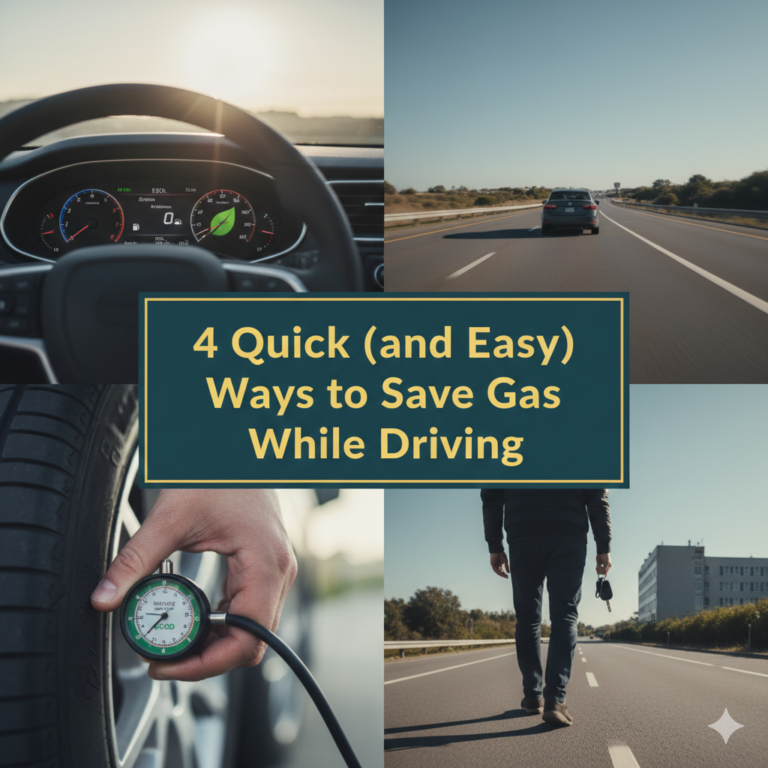
This guide exposes 4 battle-proven techniques to slash your fuel costs quickly. You will discover exactly what action to take, why it works and how much you’ll save.
Let’s get started.
Fix #1: Learn to Drive With Smoother Acceleration
Why Jackrabbit Starts Are Bad for Your Gas Mileage
There’s a meaty feeling to stomping down on the gas pedal. It’s also incredibly wasteful.
When you accelerate hard, your engine literally burns a tremendous amount of fuel to make instant power. Running rich (too much fuel). The transmission downshifts aggressively. Everything works overtime.
Research reveals that aggressive acceleration can lower fuel efficiency by 15-30% when driving in town. That’s the equivalent of throwing dollar bills out your window every time you drive through a stoplight.
Smooth acceleration does the opposite. Your engine works efficiently. Fuel burns completely. Transmission shifts gently.
The 5-Second Rule for Greater Mileage
Here’s a simple one that’s effective right away:
Hit 20 mph from a dead stop in 5 seconds.
Count it down: “One-one-thousand, two-one-thousand, three-one-thousand, four-one-thousand.”
You should be going 20 mph by second five. Not faster. Not slower.
It’s a gentle pace which allows your engine to sip fuel. It prevents wasteful over-fueling. Your transmission is shifting when it should.
Practical Application
At traffic signals: Gently but steadily apply the accelerator. Pretend there’s an egg under the pedal you’re not going to break.
Entering freeways: Use a steady, but not fast pace. You can still get from 0 to highway speed safely without flooring it.
Passing slower vehicles: Plan ahead. Take it out slowly instead of revving the gas pedal.
Real-World Fuel Savings
| Driving Style | City MPG | Highway MPG | Annual Fuel Cost* |
|---|---|---|---|
| Hard acceleration | 18 MPG | 28 MPG | $2,340 |
| Medium acceleration | 22 MPG | 31 MPG | $1,910 |
| Smooth acceleration | 24 MPG | 32 MPG | $1,760 |
*Based on 12,000 miles/year, $3.50/gallon
Gentle acceleration saves the most money — $580 a year — against aggressive driving. That’s money in your pocket for doing something that is actually easier and less stressful.
What About Traffic?
There are drivers who fear that gentle acceleration means being stuck behind the slower cars.
Now a reality check: Aggressive acceleration is seldom a time-saver. You just get to the next red light faster and wait longer.
Accelerate according to the timing of the traffic lights. Why dash to a red light, if you see one ahead? Progress steadily to the green light.
You will be burning less fuel and feeling less stressed. Win-win.
Fix #2: Brake Less, Coast More
The Hidden Cost of Every Stop
Each time you apply the brakes, you’re burning money you already shelled out.
Consider: You’ve expended fuel to accelerate your car. That fuel generated kinetic energy (movement). When you brake, that energy turns into heat in your brake pads and vanishes.
Literally turned gas money into useless heat.
Smart drivers minimize this waste. They coast whenever possible. They brake only when necessary.
Learning to Read Traffic Flow
Good coasting requires prediction. You should be able to see what’s happening 10-15 seconds down the road, not just at the car in front of you.
Look for:
- Brake lights in the distance
- Traffic lights changing
- Cars merging into your lane
- Slow-moving vehicles ahead
- Curves or hills coming up
If you recognize these situations early on, you can take your foot off the gas and coast. Your car naturally decelerates without your even having to apply the brake.
The Coasting Technique
Step 1: Remove your foot from the accelerator entirely when you see a reason to slow down in the distance.
Step 2: Allow your vehicle to slow itself naturally via engine braking. Don’t touch the brake yet.
Step 3: Brake only as much you need to finish stop or get down to safe speed.
This simple change can net you a 5%-10% fuel economy increase when driving in the city and there is plenty of stop-and-go action.
When Coasting Works Best
Approaching red lights: Take your foot off the gas 200-300 feet from each intersection. Coast to the light. It frequently changes to green before you get there.
Downhill sections: Gravity takes over. No gas pedal to ride.
Highway off-ramps: Begin coasting when you see the exit sign. You’ll just automatically slow to ramp speed.
Stop signs in neighborhoods: Coast from multiple houses away. You’ll reach the right speed without burning any extra fuel.
Safety Considerations
Coasting is not the same thing as turning yourself into a rolling menace. You’ll still have to mind the flow of traffic and pay attention.
Always:
- Keep enough following distance
- Put on your brake lights when necessary
- Maintain reasonable speed for conditions
- Stay alert to sudden changes
Coasting conserves fuel and keeps you and your fellow drivers safe. It’s smooth and predictable, not slow and unpredictable.
Fuel Savings from Better Coasting
What drivers who are good at coasting tend to notice:
- City driving: 5-10% improvement
- Suburban driving: 7-12% improvement
- Highway driving: 3-5% improvement
On a tank that usually runs $60, that’s $3 to $7 saved per fill-up thanks just to lifting your foot at certain times.
Fix #3: Discover Sweet Spot Speed for Your Car
The Speed/Fuel Relation No One Speaks Of
Each car also has a sweet spot, or an ideal cruising speed, where it consumes the least fuel. You slow down, or speed up, and you waste gas.
Most cars see peak fuel economy between 45-65 mph. These are the speeds at which your engine operates best. Aerodynamic drag is manageable. Everything works in harmony.
Beyond 65 mph, aerodynamic drag rises exponentially. Your engine is pushing its way through the air. Fuel consumption skyrockets.
At speeds below 45 mph, your engine frequently operates inefficiently. You are going slowly with a big engine. It’s a sledgehammer from which to crack a peanut.
Wind Resistance: How It Robs You Of Your Cash
Air resistance rises with the square of velocity. That means:
Increasing to 65 from 55 mph doesn’t just add another layer of 10 mph worth.
It adds wind resistance actually, about an extra 36% of it.
Your engine has to consume a great deal more fuel in order to defeat this invisible force.
Fuel Economy by Speed
| Speed | Relative Fuel Economy | Cost per 100 Miles* |
|---|---|---|
| 55 MPH | 100% (baseline) | $11.67 |
| 65 MPH | 85% efficiency | $13.73 |
| 75 MPH | 72% efficiency | $16.21 |
| 85 MPH | 60% efficiency | $19.45 |
*at $3.50/gallon and 30 MPG at 55 mph
The savings in the slower lane: $2.48 per 100 miles. That’s $12.40 saved on a 500-mile road trip simply by operating cruise control at an appropriate speed.
Finding Your Vehicle’s Ideal Speed
Cars do not have a “one size fits all” sweet spot. Here’s how to find yours:
Method 1: The Manual Check
Look in your owner’s manual. Some manufacturers do list most efficient cruising speed.
Method 2: The RPM Test
Flat highway on a calm day:
- Drive at 55 mph in top gear
- Note your RPMs (usually 1,500-2,000)
- This is usually your faster pace
If RPMs are under 1,200, you might be better off at 60 mph. If they are over 2,500, try 50 mph.
Method 3: The Real-World Test
Fill your tank completely. Drive 100 miles of highway at a constant 55 mph. Refill and calculate MPG.
Do it again at 60 mph, then at 65. That speed is your maximum miles per gallon sweet spot.
Applying This Fix
On highways: For your ideal speed, use cruise control. Let faster traffic pass. Stay in the right lane.
On the back roads: Keep a steady pace when possible. Nothing to do with unnecessary acceleration and deceleration.
In the city: This one doesn’t solve it. Focus on smooth acceleration and coasting.
What If Everyone Drives Faster?
You may feel urged to keep up with the flow of vehicles on four-lane roads. That’s understandable.
And then consider this: The speed limit is 65 or 70 mph. Being on the limit is not being slow. You’re not creating a hazard.
If traffic flows 10-15 mph over the limit all day every day you already know what to do: is it money based or time savings?
The time savings are usually marginal. A 50-mile drive at 75 mph will take you only 40 minutes. It is 46 minutes at 65 mph. Well, you save 6 minutes but burn a few extra dollars in fuel.
Your choice. But you now know the true cost.
Fix #4: Cut Weight and Drag
Your Car Is Lugging Around a Corpse
Look in your trunk right now. What’s in there?
Those golf clubs you haven’t played in months? Tools you rarely need? What emergency supplies could it contain, and therefore live in your garage?
Fuel Economy: 1-2% per Extra Weight of 100 Pounds
That may not seem like much, but it adds up.
A sedan with an additional 200 pounds (bags, equipment, junk) on board loses 2-4% fuel efficiency! Sixty to 120 dollars a year you just wasted in fuel.
The Weight Audit
Remove immediately:
- Unplayed sports gear this week
- Old school supplies still in the trunk
- Additional tools other than emergency kit
- Sandbags or weights (if you don’t need sandbags for winter traction)
- Anything you’d forgotten was still there
Keep only:
- Spare tire and jack
- Basic tool kit
- First aid supplies
- Emergency blanket
- Jumper cables
This half-hour clean-up job yields a 2-3% permanent increase in fuel economy.
Aero Drag Costs More Than You Think
In the name of carrying capacity, roof racks, bike carriers and cargo boxes create gales of wind resistance.
An empty roof rack cuts fuel economy by 5%. A heavily loaded cargo box can reduce it 10-25%. That’s huge.
Fuel Impact of External Cargo
| Accessory | Highway MPG Loss | Extra Cost per 500 Miles* |
|---|---|---|
| Empty roof rack | 2-5% | $0.70-$1.75 |
| Loaded roof rack | 5-15% | $1.75-$5.25 |
| Roof cargo box | 10-25% | $3.50-$8.75 |
| Rear-mount bike rack | 1-3% | $0.35-$1.05 |
| Rear cargo carrier | 5-12% | $1.75-$4.20 |
*30 MPG baseline, $3.50/gallon
The answer is straightforward: Remove roof racks if you’re not using them. It’s a 10-minute task, and it saves actual money.
Smart Packing for Road Trips
When a little bit of extra gear is necessary:
Inside versus outside: Load cargo inside the vehicle if you can. The cabin is already aerodynamic.
Rear-mount trumps roof-mount: Bike racks and cargo carriers mounted to the rear hatch add less aerodynamic drag than those attached to the roof.
Aerodynamic load content: If you must have a roof box, get the most aero option for it. Low-profile boxes create less resistance.
Pack tight: Secure all cargo. Anything loose and it can blow around, causing turbulence.
Window Position Matters Too
This is one that people don’t realize: Open windows at highway speeds add drag.
Open windows above 50 mph will cause turbulence that adds up to a more than 5% decrease in fuel economy. That can in fact be worse than using the air conditioner.
Best practice:
- In town (below 40 mph): Open windows are good and save you more fuel than AC
- Highway speeds (over 50 mph): Close windows and use AC at moderate level
- Sweet spot (40-50 mph): Up to you, but cracked windows, no AC tends to win
The One-Month Weight Challenge
Try this experiment:
Week 1-2: Drive as you normally would, but pay close attention to your fuel economy. Note your average MPG.
Week 3: Completely clean out your car. Remove everything unnecessary. Remove roof racks, if there are any.
Week 4: Return to your normal driving routine and track MPG once more.
At minimum, you can expect 2-5% improvement from this basic housecleaning type of activity. So, that confirms the concept and persuades you to keep the car light.
The Four Fixes Together: The Most Savings Possible
The Multiplier Effect
Here’s what makes these fixes potent: They are all stacked.
Using one technique saves money. Combining all four of them enhances your savings.
Let’s actually do the math here with a real example:
Starting point:
- Current gasoline efficiency: 22 miles per gallon city, 30 highway
- Annual mileage: 12,000 (60% City, 40% Highway)
- Gas price: $3.50/gallon
- Current annual fuel cost: $1,909
After applying all four fixes:
| Fix | City MPG Gain | Highway MPG Gain |
|---|---|---|
| Smooth acceleration | +3 MPG | +1 MPG |
| Better coasting | +2 MPG | +1 MPG |
| Optimal speed | +0 MPG | +2 MPG |
| Weight/drag reduction | +1 MPG | +1 MPG |
New totals: 28 MPG city, 35 MPG highway
New annual fuel cost: $1,481
Annual savings: $428
That is $428 in your pocket back every year without buying another car or changing where you go. You will save $2,140 after five years.
Creating Your Fuel-Saving Routine
Morning commute checklist:
- Clear out unnecessary items weekly
- Your route should be planned so you have few stops
- Accelerate smoothly from your driveway
- Coast to stop signs in your neighborhood
- Use cruise control on sections of the highway
Weekend trip checklist:
- Take off roof rack when not using
- Pack cargo inside when possible
- Determine best highway speed for your vehicle
- Organize departure times to stay away from rush hour brakes
- Use the cruise control on your vehicle when you are driving on open roads
Monthly maintenance:
- Clean the trunk out and get stuff that you’ve stored into it out as well
- Check tire pressure (properly inflated tires can save 3% on fuel)
- Review your fuel economy trends
- Adapt strategies to systems that work
Tracking Your Progress
Purchase a small pad for your car. Record:
- The date and odometer reading when each tank was filled
- Gallons purchased
- Price per gallon
- Calculated MPG
After about two months, clear patterns will emerge. You’ll now be armed with a better sense of which methods provide the greatest savings for your particular driving scenario. For more fuel-saving driving tips and strategies, you can explore additional resources to maximize your efficiency.
When These Fixes Don’t Apply
These methods are great for everyday driving. Some situations require different approaches:
Emergencies: Safety is always your number one concern. Accelerate and decelerate to keep away from accidents.
Very short trips: An engine runs inefficiently and spews out pollution when cold. Rides of 2 miles or less will have little to no gain.
Inclement weather: Snow and ice involve different driving methods that center on safety and everything else.
Towing or hauling: Loaded vehicles require an alternate approach. The basic principles will still apply but there is going to be some hit on MPG overall.
Common Myths About Fuel Economy
“Premium Gas Gives Better Mileage”
Not if your car didn’t ask for it. Premium gasoline doesn’t burn more efficiently in engines that are designed for regular gas.
Check your owner’s manual. If it says “regular unleaded recommended,” using premium throws money away without increasing fuel economy.
“AC Off Always Saves More Fuel”
True at low speeds (<40 mph). False at highway speeds.
At 50+ mph a car with open windows has significant drag.
Apply this rule: Downtown driving sans AC, highway cruising with the AC on at medium levels.
“Manual Transmissions Always Beat Automatics”
Many late-model automatic transmissions come with 7-9 gears and provide the same fuel economy as a manual transmission and are way more comfortable. It’s the driver, not the transmission, that makes a bigger difference.
“Warming Up Your Car Saves Gas”
Ancient advice for the 1980s carbureted engines. New fuel-injected engines don’t need warmup time.
Begin by starting up the vehicle and go easy for the initial 5 to 10 minutes. This warms the engine more quickly and wastes less fuel than idling.
“Refilling in the Morning Can Save You Money”
The theory: Cold fuel is denser and therefore delivers more energy per gallon.
The truth: Underground fuel tanks are at a constant temperature. Neither the time of day nor your wrist can make a detectable impact.
Helpful Tools to Save More Money
Instant Feedback Devices
Fuel economy displays are becoming increasingly common on new vehicles. Use them.
While you are driving look at your instant MPG. You will then notice right away how different behaviors impact fuel use. This sort of real-time feedback can help you learn more quickly.
You can get an OBD-II scanner with fuel economy readout ($20-50) if your car doesn’t have the feature. They plug into your diagnostic port and show live readouts on your phone.
Fuel Tracking Apps
Apps such as Fuelly, Gas Buddy and Drivvo allow you to:
- Track fuel purchases automatically
- Calculate MPG trends over time
- See how you compare to other drivers
- Find cheapest gas stations nearby
- Set fuel-saving goals
Many are free and require 30 seconds per refill to upload.
Tire Pressure Monitoring
Tires underinflated lose fuel efficiency by 0.2% per PSI drop in pressure.
You would be amazed how many tires are 5-10 PSI low and NOT look like they’re flat. This is a 1 to 2% fuel economy penalty.
Check tire pressure monthly. Invest in a reliable gauge ($10-20). Maintain the proper air pressure in tires (this can be found on a sticker inside the door jamb, not listed by manufacturers on tire sidewalls).
Cruise Control
This little device saves fuel by keeping at a steady speed. It gets rid of the micro-accelerations that waste gas.
Cruise control on highways and open areas. Cancel it in traffic where speeds fluctuate all the time.
The Psychology of Fuel-Efficient Driving
Changing Habits Takes Practice
All four fixes won’t come quickly to you. That’s normal.
Start with one technique. Do it for two weeks until it is automatic. Then add the next one.
The easiest type of acceleration for most drivers to master first is smooth. You feel better right away, and stress evaporates.
Dealing with Impatient Drivers
Drivers will pull up on your tail when you smoothly accelerate. If driving an economic speed some people will ride high. Refuse to be bullied into wasting fuel.
Strategies:
- Pull into the right lane and let them by
- Keep moving, don’t feel like you are being rushed
- Remember they’re burning more fuel to get there 30 seconds sooner, too
- Focus on your long-term savings
Making It a Game
Test yourself to see if you can beat your highest MPG. Competition (even with yourself) makes learning fun.
Set monthly goals. High five when you break your fuel economy personal best.
Tell your family members about your success. Teach them these techniques. Transform it into a household contest.
FAQs About Fuel-Saving Driving Fixes
Q: Will these techniques work with older cars?
A: Yes. These are fixes that any internal-combustion vehicle can use. Older vehicles often show even larger improvements because they start with lower fuel economy.
Q: How soon will my results appear?
A: Immediately. The very next full tank of gas is going to show a difference if you do this constantly. Full results are available on 2-3 fill-ups.
Q: Can you harm your car by accelerating slowly?
A: No. Gentle acceleration is much easier on your engine, transmission and brakes than slamming the pedal. Your car will live longer and require fewer repairs.
Q: What about diesel vehicles?
A: All four repairs apply to diesel engines. Diesels often perform even better due to their greater inherent efficiency at steady speeds.
Q: What about electric cars?
A: Gentle acceleration and coasting are good for electric vehicles as well. They extend range and reduce wear on the battery. Implement speed and weight fixes as well when making these changes.
Q: Will this actually save enough to make a difference?
A: Absolutely. If we are saving more than $400 a year, then we can say that’s over $33 per month. That’s a tank of gas, a good dinner out or savings toward a vacation. Small changes create real money.
Q: What if I own a truck or SUV?
A: They’re the ones who gain the most, because they are starting with lower fuel economy. The relative savings would be the same, but the dollar savings are greater.
Q: Are these techniques applicable to a hybrid?
A: Yes. Hybrids just make great drivers even better. You’ll make the most of electric-only mode and stretch your overall efficiency even higher.
Your Action Plan Now: Save Today
This Week
Day 1-2: Accelerate and decelerate smoothly on every trip. At stop signs or traffic lights, count to five.
Day 3-4: Add coasting technique. Look up and get off the gas earlier when you have a reason to slow down.
Days 5-6: Deep-clean your car. Remove all unnecessary weight. Take off roof racks.
Day 7: Monitor your fuel economy. Mark down where you begin, so that later you have a comparison point.
This Month
Week 2: Experiment with various highway speeds during your commute. Find your car’s sweet spot.
Week 3: Use all four techniques on each drive. Make them automatic habits.
Week 4: Determine your cost of gas. Now compare your new MPG to what you had originally as a baseline.
Long-Term Habits
- Check tire pressure monthly
- Keep car weight minimal
- Take off roof accessories if you don’t need them
- Use cruise control on highways
- Continue tracking fuel economy
The Bottom Line on Saving Gas
You don’t need a new car to save serious money on gas. You don’t require costly alterations or fancy technology.
These four fast fuel-saving driving fixes will work for anyone, anywhere, in any car:
- Gradual acceleration – Get to 20 mph over a count of 5 seconds
- More coasting – Carry speed, brake late, read traffic ahead
- Sweet spot speed – Discover and keep in mind your car’s best speed (55-65 mph)
- Reduce weight and air drag – Ditch roof racks and extra cargo
Nail these approaches, and you’ll instantly be saving 15-30% on your fuel costs. For most drivers, that’s $300-600 a year.
The techniques are free. The results are permanent. The savings are real.
According to the U.S. Department of Energy, aggressive driving can lower your gas mileage by roughly 15% to 30% at highway speeds and 10% to 40% in stop-and-go traffic, which aligns perfectly with the strategies outlined in this guide.