Why It Matters How You Drive
With each press of the gas pedal, you are deciding how much money is leaving your wallet. That little-known fact is most drivers control fuel usage more than any other single issue: their driving habits.
Think of it this way: two cars that are identical in every respect — same make, model and year — can get vastly different gas mileage simply based on how they’re driven. One will be able to cover 35 miles per gallon, the other only 25. That’s 40 percent more in fuel costs between now and a year from now.
The good news? You can save money right away just by changing the way you drive. These are not complex tricks or costly adjustments. They’re pretty easy habits to learn and start using immediately.
Gas is only getting more expensive, so every dollar adds up. So whether you’re commuting, taking the kids to school or running errands, these fuel-saving driving tips will help you save some dough and to keep your car in good shape for longer.
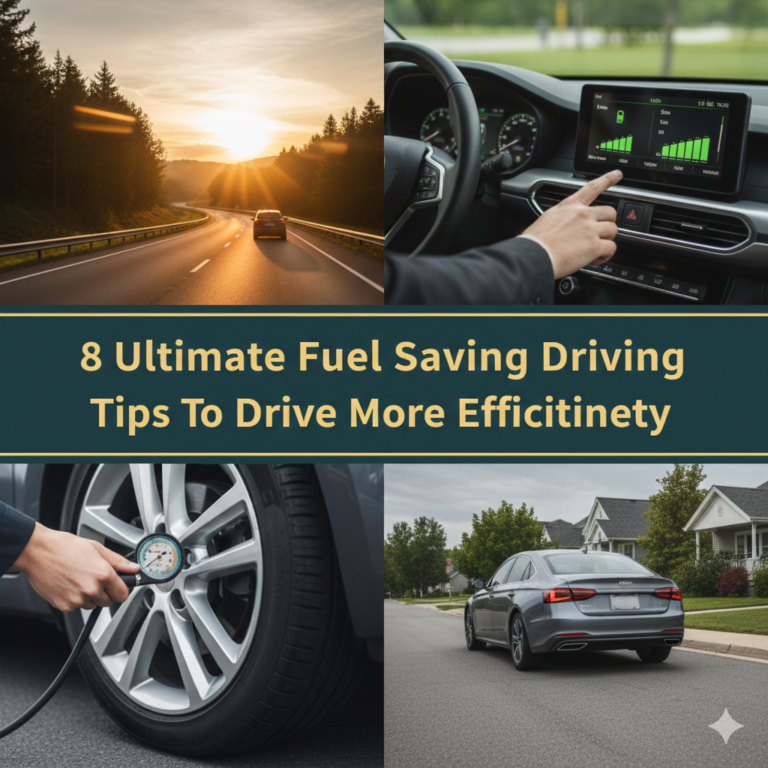
So here, we reveal eight potent tricks that will change the way you drive and cut your fuel bills.
The Smooth Acceleration Technique
Pretend you’re driving with an uncooked egg under your accelerator. That’s just about how gently you need to accelerate. Aggressive acceleration is just throwing money out your window.
Push the gas pedal to the floor, and your engine will have to work very hard. It’s glugging gas like mad just to satisfy your need for speed. Research has proven that aggressive acceleration can cost you as much as 40% more fuel in city driving.
How to Accelerate Smartly
Begin by stepping on the gas softly. You should be able to count to five in your head as you increase speed. This gradual increase enables your engine to work more efficiently while consuming less fuel.
New cars have a kind of acceleration “sweet spot.” For most cars this is around the 2,000 to 2,500 RPM mark. This is when your engine is operating most efficiently.
Here’s a good rule: If you can hear your engine howling, then you are driving too hard. The less thunderous your acceleration, the more you’ll get out of each gallon.
Real-World Impact
Consider this comparison:
| Acceleration Style | Fuel Consumption | Annual Cost (15,000 miles) |
|---|---|---|
| Aggressive | 20 MPG | $2,250 |
| Moderate | 25 MPG | $1,800 |
| Smooth | 28 MPG | $1,607 |
Based on $3.00/gallon fuel price
That’s more than $640 in less cash spent each year just by how you use one foot to push one pedal.
Maintain Steady Speed on Highways
Your car loves consistency. Your engine likes steady speed because that’s the way they find their best rhythm and operate at the highest efficiency. Here is where cruise control becomes your BFF for fuel savings.
Each time you speed up or slow down gratuitously, you’re effectively telling your engine to change its mood. They are constantly second-guessing, and they waste the fuel without getting you there any faster.
The Cruise Control Advantage
Highway driving is the best time to achieve maximum fuel efficiency. The thing about using cruise control is that it stops you from automatically changing how fast or slow you’re going.
Studies have shown using cruise control can increase fuel efficiency by 7-14 percent on flat roads. It’s not a massive amount, but it adds up fast over long trips.
Speed Selection Strategy
What many drivers do not know is that fuel efficiency plummets at speeds above 50 mph. Each time you drive 5 mph over 50, you add an additional $0.18 per gallon to the cost of gas.
Drive at a speed that is most fuel-efficient for your vehicle; typically, between 45-55 mph. At 70 mph, you’re burning about 25 percent more fuel than at 55 mph.
That said, it doesn’t mean you should drive dangerously slow. It means selecting equitable speeds and maintaining them steadily.
Master the Art of Coasting
If you’re unfamiliar with coasting, it’s one of the most rarely practiced fuel-saving habits. It’s a matter of taking your foot off the gas pedal and letting momentum push you on.
Consider the amount of energy it requires to start your car moving. And when you’re already in motion, why burn that energy braking and re-accelerating?
When to Coast Effectively
Begin coasting when you first notice a red light up ahead. And you can’t keep going as fast if you’re just going to have to stop. Let physics do the work.
Approaching a stop sign? Start coasting 200-300 feet before you need to apply the brakes. You will have arrived in the same time but saved fuel and wear on your brakes.
Coasting works great on the downhill parts. Your car naturally wants to roll downhill. Why argue with gravity using your accelerator?
The Science Behind Coasting
Newer cars with fuel injection stop fuel delivery completely while coasting in-gear. That means zero fuel is involved, in the true sense of the words, even as you move. That’s about as economical as it gets.
Consider idling at a red light, you’re sitting there burning gas for no movement at all. Coast strategically and you’ll use 10-15 percent less fuel around town.
Drive Like a Pro: Predicting the Traffic Flow
Good drivers have access to a secret weapon: They read the road. They are not just looking at the car in front of them. They are actually looking 10-15 seconds ahead, thinking about what is coming next.
This is the foresight that you want when driving efficiently. The ability to anticipate traffic changes allows you to avoid unnecessary braking and accelerating.
Developing Traffic Awareness
Peer through the windows of cars in front of you. This provides a warning of brake lights and traffic slowdowns.
Look at traffic signals that you’ll see in the distance. If a stoplight up ahead just turned green, it could be red by the time you reach it. No need to speed up.
Notice patterns in traffic flow. Does the traffic invariably slow at that intersection? Get ready for it before you come.
Gap Management
Maintain larger following distances. This allows you to coast and vary speed smoothly instead of constantly braking.
A helpful guide is the three-second rule. Choose some fixed object, and see how long exactly after the car ahead has passed it you reach it. Three seconds is enough time for a smooth response.
| Following Distance | Braking Frequency | Fuel Efficiency Impact |
|---|---|---|
| 1-2 seconds | High | Poor |
| 3-4 seconds | Moderate | Good |
| 5+ seconds | Low | Excellent |
How to Choose the Right Gear in a Manual Transmission
Manual transmission? One of the biggest ways to save fuel is right between your legs: gear selection.
The higher the gears, the lower the engine RPM at a given velocity. The lower the RPM, the less fuel used. It’s that simple.
Shift Earlier, Save More
Most drivers shift too late. They hold out, wait until the engine is howling before shifting to the next gear. This is a tremendous waste of fuel and causes undue wear on the engine.
Try shifting at lower RPM. For the majority of cars, between 2,000-2,500 RPM is seen as being one of the sweet spots for fuel economy. You may feel as though you have an early upshift, but it will save your engine and some cash.
The Top Gear Strategy
Place yourself in your highest gear as soon as possible. But if you’re driving 40 mph in third gear, you are using much more fuel than you would be in fourth or fifth gear at the same speed.
The modern engines have all the torque in the world even down low. Feel free to shift into higher gears much sooner than you think necessary.
Avoiding Lugging
There’s a balance to strike. If your engine stumbles or shakes, then you’ve over-selected the gear. This is known as “lugging” and is actually worse for fuel economy than being in a lower gear.
Listen to your engine. It should feel happy and eager to respond when you stomp the gas. If it doesn’t, downshift.
Reduce Idle Time Wherever Possible
Let’s face it: idling gets you 0 miles per gallon. You are burning fuel but you’re not moving forward.
The old instruction to let your car warm up for several minutes? That’s outdated. Newer engines heat up faster when driven easily than sitting still.
The 10-Second Rule
If you will be idling for more than 10 seconds, turn off your engine. Starting up requires less fuel than idling for that amount of time.
Most new cars have automatic start-stop systems these days. You can also manually turn off your car, if it doesn’t have this feature.
Common Idling Situations
Drive-through lines are giant fuel suckers. Think about parking the car and going inside instead. You’ll use less fuel, and you may well get served more quickly.
Waiting to pick someone up? Turn off the engine. In such cases, most people idle for 5-10 minutes, using a quarter gallon of fuel or more.
Another chance to turn off the engine instead of idling: bank ATMs and pharmacy pickups.
Cold Weather Considerations
Even in the dead of winter, 30 seconds is sufficient. Your engine heats up far more quickly by being driven gently than by sitting there.
It’s also preferable for heating the cabin when driving, predominantly due to the fact that the more heat an engine generates, its heat output increases even further under load.
Proper Tire Pressure Maintenance
Your tires are, quite literally, where the rubber meets the road. They’re a massive factor in fuel economy that most drivers totally overlook.
Under-inflated tires increase rolling resistance. Your engine has to do more work to propel the car forward. This can result in a fuel economy loss of 0.2% per one PSI drop in the tire pressure.
Checking and Maintaining Pressure
Check your tire pressure monthly. Temperature changes affect pressure significantly. Tires lose one pound per square inch of pressure for every 10-degree drop in temperature.
The proper pressure is printed on a sticker inside your driver’s door jamb. Don’t inflate to tire’s maximum pressure printed on the sidewall. That is not the optimal operating pressure.
Buy a good quality tire pressure gauge. Gas station gauges can be wrong. A $10 gauge could save you hundreds in gas.
The Real Numbers
| Tire Pressure Status | Rolling Resistance | Fuel Economy Impact |
|---|---|---|
| 10 PSI under | +15% | -2-3% MPG |
| 5 PSI under | +8% | -1-2% MPG |
| Properly inflated | Baseline | Optimal |
| 3 PSI over | -2% | +0.5% MPG |
You may want to inflate 3-5 PSI above recommended for highway trips. This increases mileage slightly while still being safe.
Additional Tire Tips
A set of properly aligned wheels avoids uneven wear on tires and minimizes rolling resistance. Get your alignment checked annually.
Opt for fuel-efficient tires when the time comes to get replacements. Low rolling resistance tires can give an increase in fuel economy of 1-2% without extra effort.
Minimize Air Conditioning Usage
Your A/C unit is a major power suck. In the city, it can cut fuel economy by as much as 25 percent; on the highway by 10 percent.
That doesn’t mean sweating it out in summer heat. It’s about strategically deploying when and how you use climate control.
Temperature Management Strategies
Park in shade whenever possible. The cooler the car, the less you need to use AC for it to get comfortable.
Put the vent on for air but do not engage the compressor. Open windows become more drag-inducing than the AC at over 40 mph—a good incentive to run that climate control at highway speeds.
Put your AC in recirculate mode. This cools already-cooled air rather than hot outside air, which means your system works less.
The Ideal Point for Comfort and Performance
Set the thermostat at 72-74°F, rather than its coldest setting. That way, the compressor has less work to do and you stay comfortable.
Take advantage of any automatic climate control that your car may be equipped with. By controlling temperature automatically, these systems help you use less energy (and save money).
Crack windows open a bit for ventilation on cooler days. The minimal hit of drag is smaller than the power AC uses while in the city.
Winter Heating Efficiency
Heating is taking advantage of engine waste heat, not directly drawing off fuel like AC. But maximum heat does require the engine to do a little more work to produce that heat.
Use seat warmers if available. They heat you directly with a fraction of the electricity needed, allowing you to keep cabin temperature lower.
Frequently Asked Questions
What kind of savings can I expect to realistically see from these driving habits when it comes to money?
By practicing all of these habits, the average driver can save 15-25% on fuel costs. For the person who drives 15,000 miles a year getting 25 mpg and paying $3 for gas that’s annual savings of between $270 and $450. That’s enough for a nice vacation after five years.
Will these habits also be effective when it comes to diesel cars?
Absolutely. These rules are common for any internal combustion engine. Diesel-engined vehicles also commonly fare better as diesel engines naturally perform best with steady speeds and soft acceleration.
Will driving more efficiently compromise the performance and longevity of my engine?
In fact, these habits add life to the engine. Smooth acceleration, using the right gear and less idling, all reduce wear on your engine. You could save on maintenance expenses and gain fuel efficiency.
How long does it take before one of these habits can start showing its fuel-saving effect?
Many people see some improvement in the first week. It can take up to 30 days of deliberate practice for these behaviors to become reflexive. Begin with one or two habits; then gradually incorporate others.
Can I do these things and still drive safely?
Safety always comes first. In fact, these tendencies make you a safer driver since they involve being more alert and having a more gentle feel for the car. Never trade off safety to save a few dimes.
Do modern cars with eco-modes make these habits unnecessary?
Eco-modes will help, but the most effective way to use them is when you add in the proper driving habits. Throttle response or shift points might change in the mode, but you remain in control of acceleration intensity and speed selection.
Act Now For Good Gas Mileage
That’s 8 mighty little weapons in your fuel-strategy arsenal. These are not mere temporary tricks or gimmicks. They are sustainable habits that will endure as long as you are driving.
Start small. Choose two or three habits that appear to be the easiest to incorporate. Start with perhaps a gentle application of power and then holding it steady. Once those feel automatic, incorporate another habit or two.
Track your progress. Record your fuel mileage before making interventions and check it weekly. You can see your car’s average MPG right on the dashboard of most cars. The temptation to form new habits is inspired by continued improvement in numbers.
The other great thing about fuel-saving driving habits is that they are good for a multitude of reasons. You will save money on gas, reduce wear on your vehicle, lower emissions and become a more relaxed, attentive driver. Your passengers will feel smoother rides. You will reduce your stress as you no longer speed and battle traffic.
And always remember that every trip is an opportunity to practice. Your morning commute is an opportunity to work on your technique. You have plenty of long highway drives to perfect your cruise control strategy.
These habits do not necessitate costly equipment or vehicle changes. You don’t need a hybrid or electric car to see huge gains. It’s just a matter of being aware and having commitment to smarter driving.
The money you save adds up over time. That savings of $40 a month becomes $480 annually. If you drive the average amount for a decade, that’s about $5,000 in fuel savings alone. Factor in lower maintenance costs and the tally only increases.
Start today. Your next trip is your first chance to develop these fuel-efficient driving habits. Focus on smooth acceleration, or see how long you can coast to the next red light. Little things have a big impact when you do them every day.
For more detailed information on fuel efficiency and vehicle maintenance, check out the U.S. Department of Energy’s fuel economy guide.
Your wallet, your vehicle and the planet will thank you for these easy-to-implement driving changes. The first step to achieving better fuel economy is a single, gentle press of the gas pedal.