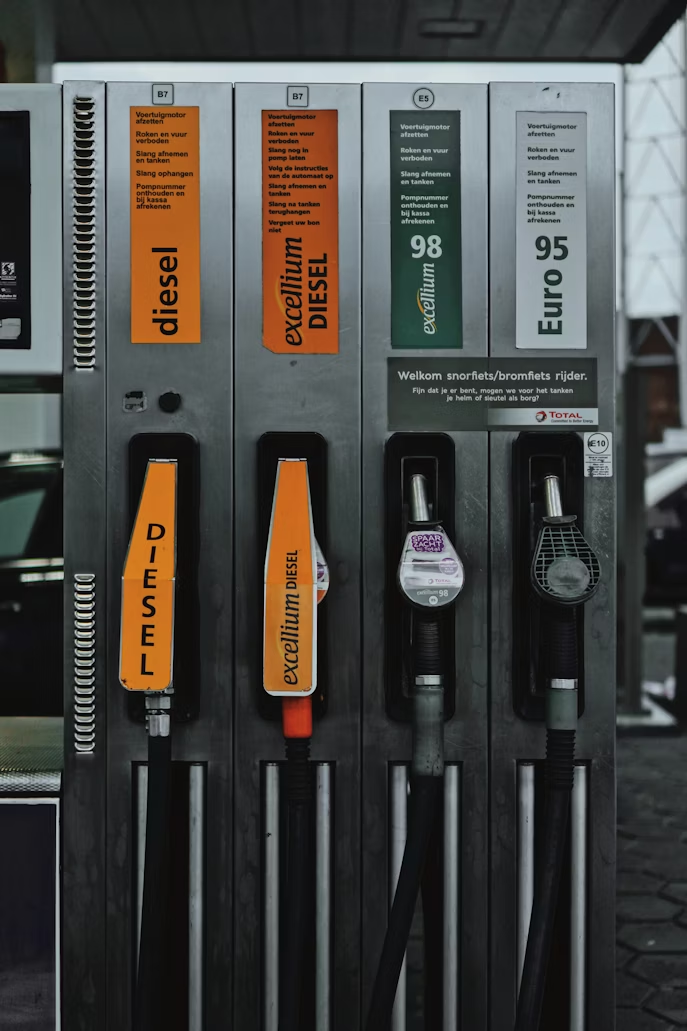
There’s a moment most drivers eventually reach—usually at a fuel station—when the numbers on the pump climb faster than expected. It’s not just about rising fuel prices anymore; it’s about how much of that cost is actually within your control.
What’s changed over the past decade isn’t just engine technology, but the ecosystem around it. A wave of innovations—some subtle, some transformative—has quietly redefined how fuel efficiency can be improved without replacing your vehicle.
This isn’t about gimmicks or exaggerated claims. It’s about practical, tested innovations that reshape either how your car behaves or how you interact with it. Some are rooted in engineering, others in software, and a few simply make inefficiencies visible for the first time.
Below are eight fuel-saving innovations that stand out not because they promise miracles, but because they consistently deliver measurable results when used correctly.
how modern fuel-saving innovations differ from older solutions
Traditional fuel-saving advice focused on habits: drive slower, reduce weight, keep tires inflated. While still valid, these approaches rely heavily on discipline.
Modern innovations do something different—they automate, guide, or optimize decisions in real time.
Here’s a quick contrast:
| Aspect | Traditional Approach | Modern Innovation |
|---|---|---|
| Driver Effort | High | Low to Moderate |
| Feedback | Minimal | Real-time |
| Consistency | Variable | High |
| Measurable Impact | Hard to track | Data-driven |
innovation 1: real-time fuel analytics systems
These systems plug into your vehicle’s diagnostic port and provide continuous data on fuel consumption, engine load, and driving patterns.
At first, it feels like overkill—numbers, graphs, efficiency scores. But within a few drives, patterns begin to emerge. You notice how quickly fuel consumption spikes during aggressive acceleration or how idling eats into efficiency.
sample data snapshot:
| Driving Behavior | Fuel Consumption Impact |
|---|---|
| Smooth Acceleration | Low |
| Rapid Acceleration | High |
| Idling (5+ minutes) | Very High |
What makes this innovation powerful is not just the data, but the awareness it creates. Drivers tend to self-correct once inefficiencies are visible.
estimated improvement: 8–15%
innovation 2: adaptive throttle response systems
Throttle response used to be purely mechanical. Now, it can be tuned electronically to prioritize efficiency.
Adaptive systems adjust how quickly your car responds to pedal input. In eco mode, acceleration becomes gradual, preventing unnecessary fuel spikes.
real-world comparison:
| Input Style | Standard Response | Adaptive Eco Mode |
|---|---|---|
| Light Press | Moderate Power | Gentle Increase |
| Hard Press | Instant Surge | Controlled Rise |
This isn’t about limiting performance—it’s about smoothing out the wasteful extremes.
estimated improvement: 6–12%
innovation 3: intelligent tire pressure monitoring with auto-adjust alerts
Basic tire pressure monitoring systems already exist, but newer versions go further. They don’t just alert you—they recommend optimal pressure based on load, temperature, and driving conditions.
why it matters:
Underinflated tires increase rolling resistance, forcing the engine to work harder.
impact chart:
| Tire Pressure Status | Rolling Resistance | Fuel Efficiency |
|---|---|---|
| Low | High | Reduced |
| Optimal | Balanced | Improved |
Some advanced systems even integrate with mobile apps, making maintenance proactive instead of reactive.
estimated improvement: 3–7%
innovation 4: automatic engine start-stop technology
This innovation has become more common in newer vehicles, but aftermarket systems are also available.
The concept is simple: when your car is stationary—at a red light or in traffic—the engine shuts off automatically and restarts when you’re ready to move.
urban driving analysis:
| Condition | Without System | With System |
|---|---|---|
| Idle Fuel Use | Continuous | Minimal |
| Engine Activity | Constant | Intermittent |
In congested environments, the savings add up quickly.
estimated improvement: 8–12% (city driving)
innovation 5: predictive navigation with fuel optimization
Modern navigation apps don’t just find the fastest route—they can now calculate the most fuel-efficient one.
They factor in:
- Traffic density
- Elevation changes
- Stop frequency
- Average speed patterns
route comparison example:
| Route Type | Distance | Stops | Fuel Use |
|---|---|---|---|
| Shortest Route | 10 km | High | Higher |
| Optimized Route | 12 km | Low | Lower |
This flips a common assumption: the shortest route isn’t always the cheapest in terms of fuel.
estimated improvement: 5–10%
innovation 6: low rolling resistance materials and components
Beyond tires, manufacturers are now integrating low-resistance materials into wheel bearings, lubricants, and drivetrain components.
These reduce internal friction, allowing the vehicle to operate more efficiently.
component comparison:
| Component Type | Standard Friction | Optimized Friction |
|---|---|---|
| Conventional Parts | Higher | — |
| Low-Resistance Parts | — | Lower |
While the impact per component may seem small, the cumulative effect is noticeable.
estimated improvement: 4–8%
innovation 7: lightweight structural enhancements
Weight plays a direct role in fuel consumption. New materials—such as aluminum alloys and composite panels—reduce vehicle mass without compromising safety.
Even small reductions matter.
weight vs efficiency:
| Weight Reduction | Fuel Efficiency Gain |
|---|---|
| 5% | 2–3% |
| 10% | 5–6% |
Aftermarket options like lightweight wheels or components can replicate some of these benefits.
estimated improvement: 3–6%
innovation 8: smart driving assistants with eco coaching
These systems act like a co-pilot focused on efficiency. They analyze driving patterns and provide real-time suggestions:
- Ease off the accelerator
- Shift earlier (for manual cars)
- Maintain steady speed
sample feedback loop:
| Action Detected | System Suggestion |
|---|---|
| Hard Braking | Reduce speed earlier |
| Rapid Acceleration | Apply gradual throttle |
| Speed Fluctuation | Maintain consistency |
Over time, these suggestions become habits.
estimated improvement: 7–14%
combined innovation impact
Individually, each innovation offers incremental gains. Combined strategically, the impact becomes substantial.
example combined scenario:
| Innovation Set | Total Efficiency Gain |
|---|---|
| Analytics + Eco Driving Assistant | 12–20% |
| Start-Stop + Predictive Navigation | 15–22% |
| Tire Optimization + Lightweight Components | 8–13% |
The key is avoiding redundancy—stacking similar tools doesn’t always double the benefit.
cost vs benefit overview
| Innovation | Cost Level | Savings Potential | Payback Speed |
|---|---|---|---|
| Fuel Analytics System | Low | Medium | Fast |
| Adaptive Throttle | Medium | Medium | Moderate |
| Smart TPMS | Low | Low-Medium | Fast |
| Start-Stop System | Medium | High (City) | Moderate |
| Predictive Navigation | Free/Low | Medium | Immediate |
| Low-Resistance Components | Medium | Medium | Moderate |
| Lightweight Enhancements | Medium | Low-Medium | Slow |
| Eco Driving Assistant | Low | Medium | Fast |
behavioral shift vs mechanical improvement
One of the most interesting takeaways is how behavioral innovations often outperform mechanical ones.
Why?
Because inefficiency is often human-driven. Sudden acceleration, inconsistent speeds, and unnecessary idling can waste more fuel than mechanical inefficiencies.
Innovations that guide behavior—analytics systems, eco assistants, navigation tools—tend to deliver faster and more consistent results.
real-world monthly savings projection
| Monthly Fuel Budget | 10% Savings | 20% Savings |
|---|---|---|
| $120 | $12 | $24 |
| $250 | $25 | $50 |
| $400 | $40 | $80 |
Over a year, even modest improvements compound significantly.
mistakes to avoid when adopting new innovations
It’s easy to get excited about new technology, but not all implementations lead to results.
Common pitfalls include:
- Expecting instant results without adapting driving habits
- Over-investing in overlapping technologies
- Ignoring maintenance basics
- Misinterpreting short-term fluctuations as long-term trends
Fuel efficiency improvements require consistency. Innovations amplify good habits—they don’t replace them.
a practical roadmap for adoption
If you’re considering upgrading your approach to fuel efficiency, a phased strategy works best.
phase 1: awareness
Start with analytics tools and driving assistants.
phase 2: control
Introduce throttle management and route optimization.
phase 3: optimization
Upgrade tires, components, or add start-stop systems.
phase 4: refinement
Fine-tune based on your driving environment (city vs highway).
This layered approach ensures you get maximum value without unnecessary spending.
final reflections
Fuel-saving innovations are no longer niche—they’re becoming part of everyday driving. But their real value lies in how they interact with you as a driver.
The most effective tools don’t just change the car—they change your relationship with it. They make inefficiency visible, encourage smoother habits, and quietly reduce waste over time.
Ignoring these innovations doesn’t just mean missing out on savings—it means continuing to pay for inefficiencies that are now avoidable.
frequently asked questions
- Are fuel-saving innovations worth the investment?
Yes, especially those that influence driving behavior or reduce inefficiencies. Many recover their cost within months. - Which innovation delivers the biggest impact?
Start-stop systems and real-time analytics tend to offer the most noticeable improvements, particularly in city driving. - Can older cars benefit from these technologies?
Absolutely. Many tools, like OBD2 systems and navigation apps, are designed specifically for older vehicles. - Do these innovations affect vehicle performance?
Most are designed to balance efficiency and performance. Eco modes may feel smoother rather than slower. - How quickly can I see results?
Some changes are noticeable within days, while others take a few weeks of consistent use. - Is it better to combine multiple innovations?
Yes, but choose complementary tools. Combining behavioral and mechanical improvements yields the best results.
In the end, fuel efficiency is no longer just about driving less—it’s about driving smarter. And with the right innovations, that shift becomes not only possible, but surprisingly easy.